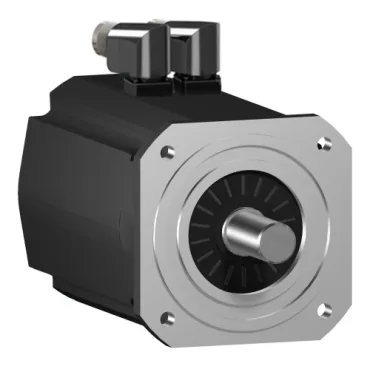
Does the SH32051P02F2200 still answer a current-production servo brief?
Holding torque lands at 708.06 lbf.in (80 N.m), with peak stall torque rated 973.6 lbf.in (110 N.m) across 115–480 V three-phase operation, so the motor covers both a sustained working envelope and short-duration overload without stepping to a larger frame.
Where the continuous and nominal torque windows actually pin the fit
Continuous power is 5500 W at 400 V three phase, dropping to 5200 W at 480 V three phase, 4240 W at 230 V single phase, and 2510 W at 115 V single phase, with nominal torque scaling the same way from 154.9 lbf.in (17.5 N.m) at 400 V three phase down to 122.1 lbf.in (13.8 N.m) at 480 V three phase. Continuous stall torque is 326.6 lbf.in (36.9 N.m) across 115–480 V three phase, so the servo holds rated torque at zero speed without exceeding the 266 °F (130 °C) winding temperature limit when the drive current loop is set per the SH3 tuning profile. Maximum current (Irms) is 87.2 A and the 3-second peak output current is also 87.2 A, indicating the drive loop ceiling — the motor is matched to a Lexium or equivalent servo drive whose continuous and peak current envelope aligns with this figure rather than a higher-rated module.
Encoder feedback and shaft geometry a designer has to match
Mounting follows the international standard flange with an 8.07 in (205 mm) motor flange and a 7.09 in (180 mm) centring collar at 0.2 in (4 mm) depth, and the four mounting holes are 0.6 in (14 mm) diameter, giving a bolt circle the panel builder can drill without a custom fixture plate.
Shaft loading, rotor inertia, and the duty class this motor actually serves
Maximum radial force Fr is 3730 N at 1000 rpm, 2960 N at 2000 rpm, and 2580 N at 3000 rpm, with maximum axial force Fa of 740 N, so a belt or gear drive must be positioned within the radial-load envelope of the speed range — exceeding Fr at low rpm is the usual failure path on high-inertia servos.
Thermal envelope, sealing, and where the motor physically sits
Cooling is natural convection with no integrated fan, so the motor must be mounted with the housing clearances the SH3 manual calls out and not packed into an enclosed cabinet where the 266 °F (130 °C) winding limit can be approached under continuous stall.
Electrical constants the drive commissioning engineer needs
Stator resistance is 0.3 Ohm with 8.7 mH stator inductance, a torque constant of 1.75 N.m/A at 248 °F (120 °C), and a back-EMF constant of 104 V/krpm at 68 °F (20 °C) — these are the loop-tuning inputs the drive auto-identification routine uses on first commissioning. Nominal speed steps through 750 rpm at 115 V single phase, 1500 rpm at 230 V single phase, 3000 rpm at 400 V three phase, and 3600 rpm at 480 V three phase, so the drive voltage class — not just the power class — selects which speed point the application runs at. The motor has 5 poles and uses a rotatable right-angled connector for the power and feedback cable, which means the cabinet-side cable entry can be rotated to match the gland plate orientation without re-terminating the connector.