Motor specs that matter on the line
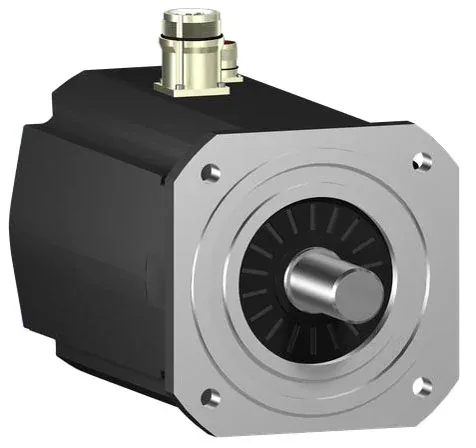
The SH32052P02F1000: This is a three-phase servo motor from the SH3 series, sized for 7900 W continuous power. The nominal speed is supply-dependent: 500 rpm at 115 V single phase, 1000 rpm at 230 V single phase, 2000 rpm at 400 V three phase, and 2400 rpm at 480 V three phase. That means on a standard 400 V three-phase line you get 2000 rpm — match it to the drive's output voltage to hit the target speed without overspeeding. Nominal torque also shifts with voltage: 61.6 Nm at 115 V single phase, 56 Nm at 230 V single phase, 38.1 Nm at 400 V three phase, and 28.4 Nm at 480 V three phase. The continuous stall torque is 64.9 Nm across the 115–480 V three-phase range, so the motor can hold a load at standstill at that torque regardless of supply. Peak stall torque hits 220 Nm — useful for short-duration acceleration or clearing a jam.
Encoder, brake, and feedback loop
Fitted with an absolute multiturn SinCos Hiperface encoder. That's a high-resolution feedback device — the drive gets absolute position at power-up, no homing cycle needed. The SinCos analog track gives fine interpolation for velocity loops. If the machine does synchronized motion or electronic gearing, this encoder saves a reference run on every restart.
Mounting, shaft, and environmental fit
The motor uses an international standard flange with a 205 mm flange size and 180 mm centring collar. The shaft is 38 mm diameter, smooth (no keyway), 80 mm shaft length — that's a direct-couple interface, typically using a clamping hub or shrink disc. The mounting holes are 14 mm diameter on the flange face. IP rating depends on the shaft seal: IP54 at the shaft bushing without the seal ring, IP65 on the motor body, and IP65 at the shaft bushing with the seal ring fitted. That means in a dry cabinet it runs IP65, but if washdown is required, the shaft bushing needs the seal ring to keep water out of the bearing area. Natural convection cooling — no fan, so it relies on the machine frame or ambient airflow for heat rejection.
Electrical connections and thermal limits
Two connection options: a rotatable right-angled connector and a straight connector. That gives flexibility for cable routing in tight cabinets — the right-angled version can be oriented to clear adjacent components. Maximum current is 96.8 A RMS, with the same 96.8 A as the 3-second peak output current. The stator resistance is 0.3 ohm and inductance 2.95 mH, which sets the drive's current-loop tuning parameters. Copper winding temperature is rated to 130 °C hot. The torque constant is 2.52 Nm/A at 120 °C — that's the hot rating, so at room temperature the torque per amp is slightly higher. Back EMF constant is 161 V/krpm at 20 °C, which helps the drive calculate the motor's voltage demand at speed. Maximum axial force on the shaft is 740 N; radial force limits are 4200 N at 1000 rpm, 3330 N at 2000 rpm, and 2910 N at 3000 rpm — stay under these to avoid bearing overload.