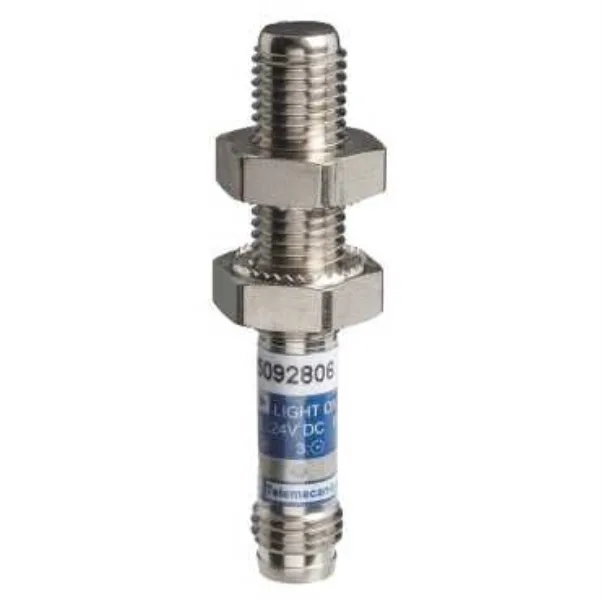
The Telemecanique XUAH0214S sits in the XUA miniature photoelectric family and is the receiver half of a tubular through-beam pair, threaded in a nickel-plated brass M8 barrel body. It carries the same through-beam sub-class as the rest of the XUA line and is the part a buyer drops into a 2 m optical gap. Optical range is fixed at 2 m between emitter and receiver, which is the working distance the rest of the install (bracket, reflector of sight line, conduit routing) has to accommodate. Detection speed is the figure that decides whether the sensor survives a high-speed conveyor or small-parts counting job: response is 0.25 ms ON and 0.25 ms OFF, with a switching frequency ceiling of 2000 Hz, so it is rated for lines running well into the kHz pulse band.
Electrical interface and wiring
Power is 12 to 24 VDC on a 3-wire hookup, terminated through an M8 3-pin DC nano male connector — the same nano footprint used across the XUA family, so standard M8 3-pin nano cordsets apply. Output is configured as PNP normally-open, with a maximum load current of 100 mA — the figure that determines whether the receiver can drive a relay coil, a PLC fast input, or only a signal-level load. The lens is PMMA, which keeps optical losses low at visible and near-IR wavelengths typical of this class and avoids the fragility of glass in a washdown-mounted barrel.
Environmental rating and approvals
Sealing is rated to NEMA 4, 6, 6P, 12 and 13 and to IP65 and IP67, so the housing stands up to hose-down, coolant splash and the dust of a typical packaging or machining cell. Compliance markings on record are UL and CE.
Sourcing posture
Lifecycle stage is recorded as current, so the XUAH0214S is specified into the BOM on the active Telemecanique XUA line rather than on a last-time-buy window. The line carries a California Prop 65 warning for DINP and DIDP, which is part of the standard shipping paperwork for this code rather than a flag on the part itself — useful to know if the receiving site files Prop 65 declarations.
Buyer close
For a controls integrator, the call is straightforward: the 2 m range, the 12–24 VDC PNP NO output on an M8 nano, and the 0.25 ms response cover the usual through-beam jobs in a small-format sensor, with UL and CE already on the nameplate — quote this code into the BOM and source it to order against an RFQ.