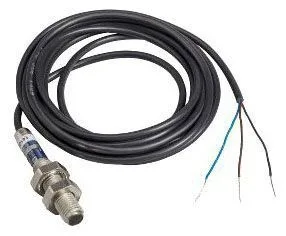
The part on the bench
The Schneider Telemecanique XUAH0224 is a tubular photoelectric through-beam detector in the miniature XUA series, built around a threaded nickel-plated brass housing with a PMMA lens. It pairs with a separate source unit on a 2 m optical axis — the listed sensing distance — and switches a DC load through a 3-wire PNP output. It runs on 12 to 24 VDC and sinks up to 100 mA on the switched leg, with an NC PNP output configuration and UL/CE approvals carried on the spec line. The 0.25 ms on/off response and 2000 Hz switching ceiling set the maximum detectable event rate, which matters on indexing conveyors or small-part counting stations where a slower sensor would miss a pulse.
What the housing and termination actually mean
Threaded nickel-plated brass housing sealed to NEMA 4/6/6P/12/13 and IP65, IP67, suits washdown and mild-chemical environments typical of food, beverage, and bottling lines. The 2 m PVR cable flying-lead termination commits cable gland entry and harness length at order time — a panel retro-fit needing a quick-disconnect should look at the 'S' suffix variant instead.
Cable version vs. M8 connector variant
The closest same-function sibling is the XUAH0224S, which carries the same 2 m range, NC/PNP output, 12-24 VDC supply, 100 mA load, 2000 Hz switching, and UL/CE approvals but terminates in an M8 3-pin DC nano male connector instead of the 2 m PVR cable. On a panel that was specified around the XUAH0224S the cable version will not drop in without re-terminating the harness or adding a cordset; the sensing performance is identical, the wiring is not. The XUAH0214S is the same M8-connector mechanical package but flips the output to NO/PNP, which is the right swap only if the PLC input was actually wired to look for a high-going edge — a NO/NC substitution is never silent on a safety or interlock circuit.
The XUAH0224 carries a current lifecycle stage, and the XUA series remains a current Telemecanique / Square D family in the Schneider line, so this is still a supported order code rather than a last-time-buy.