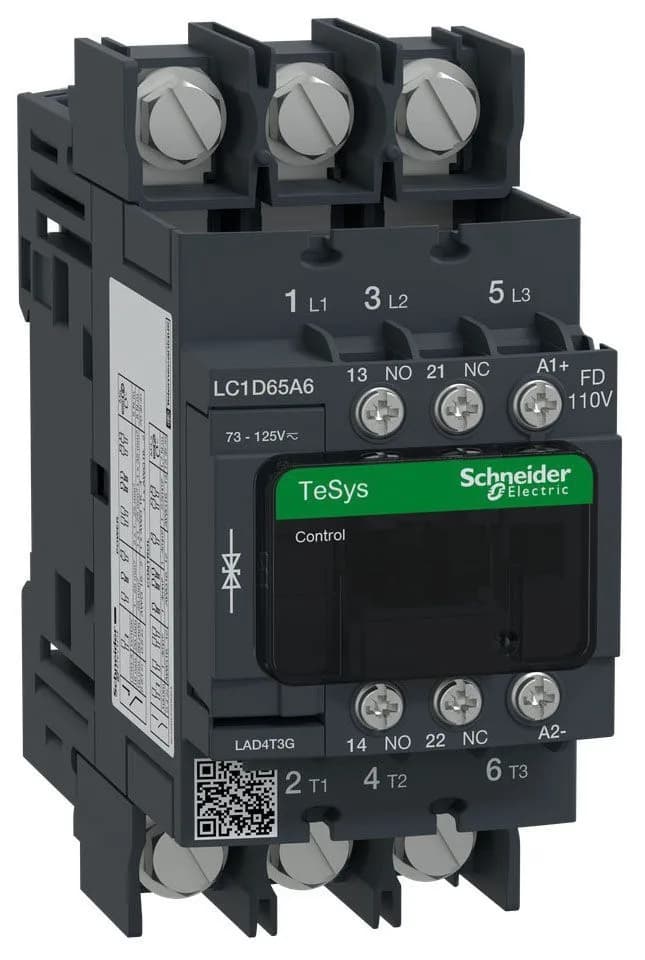
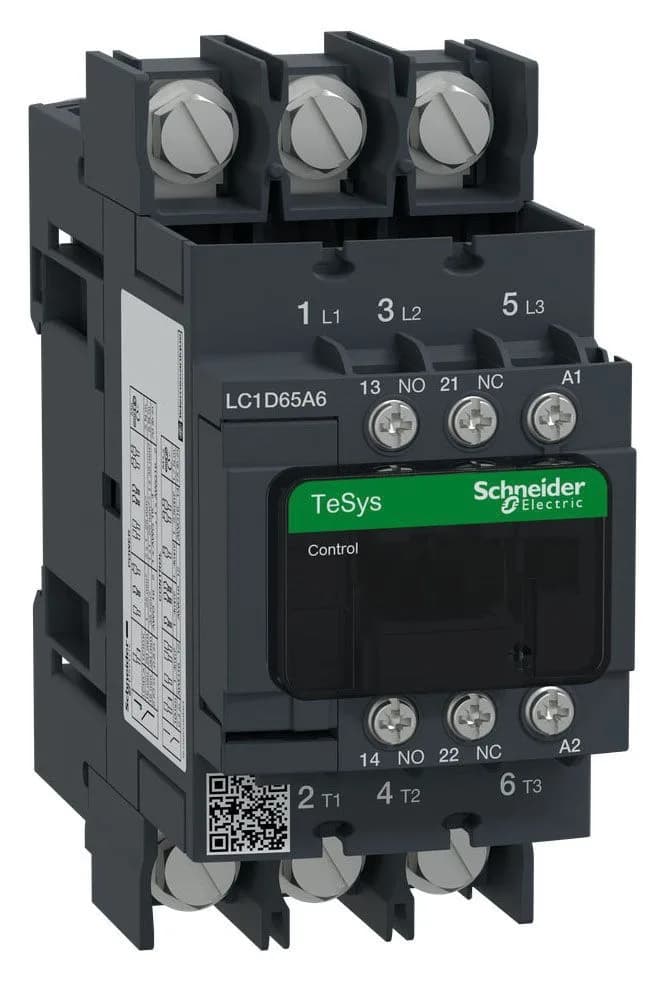
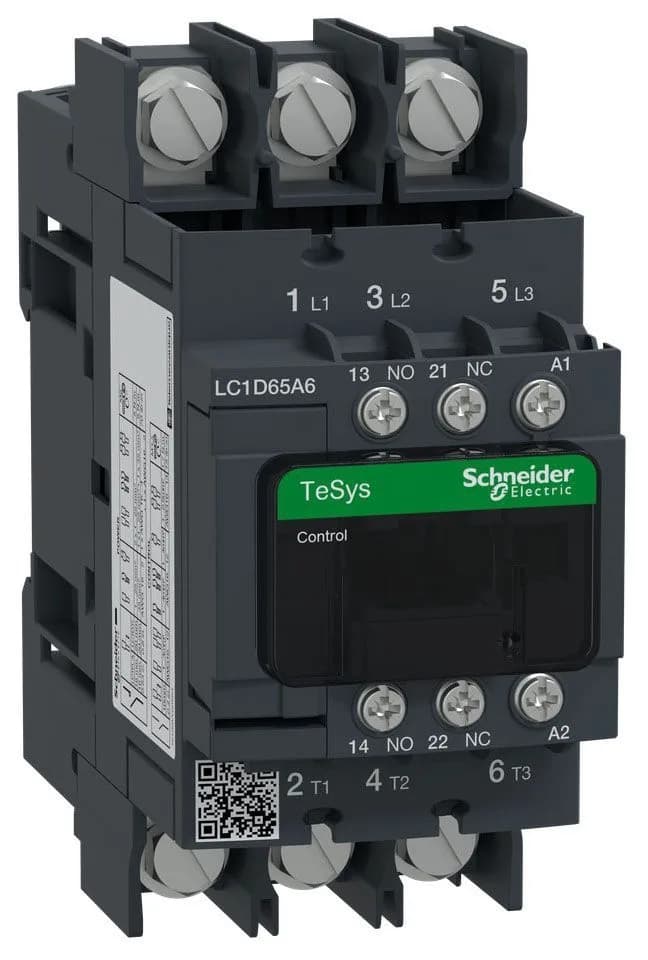
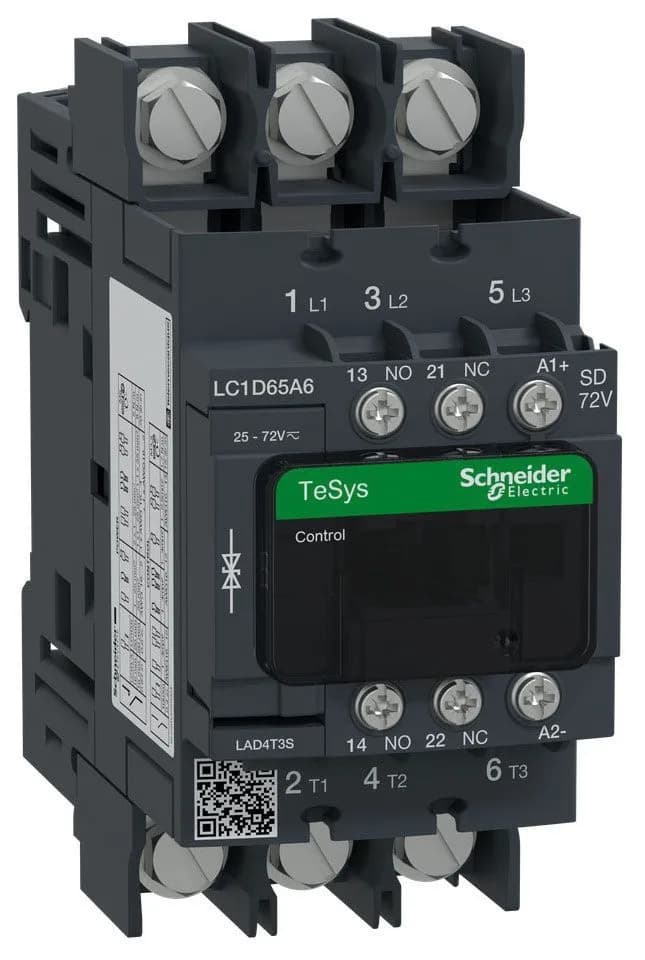
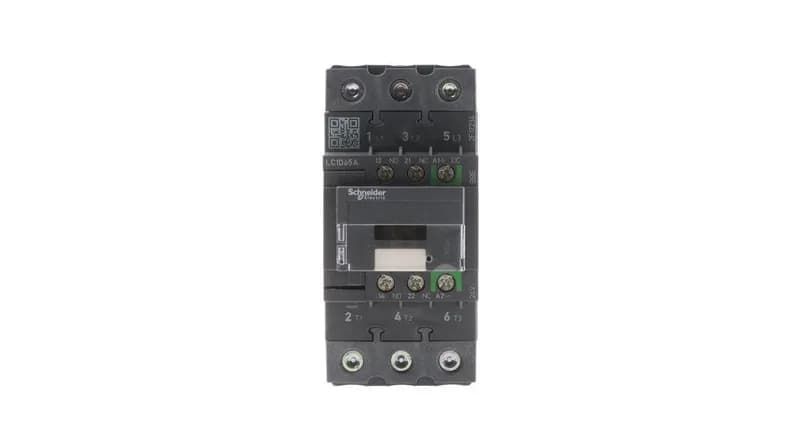
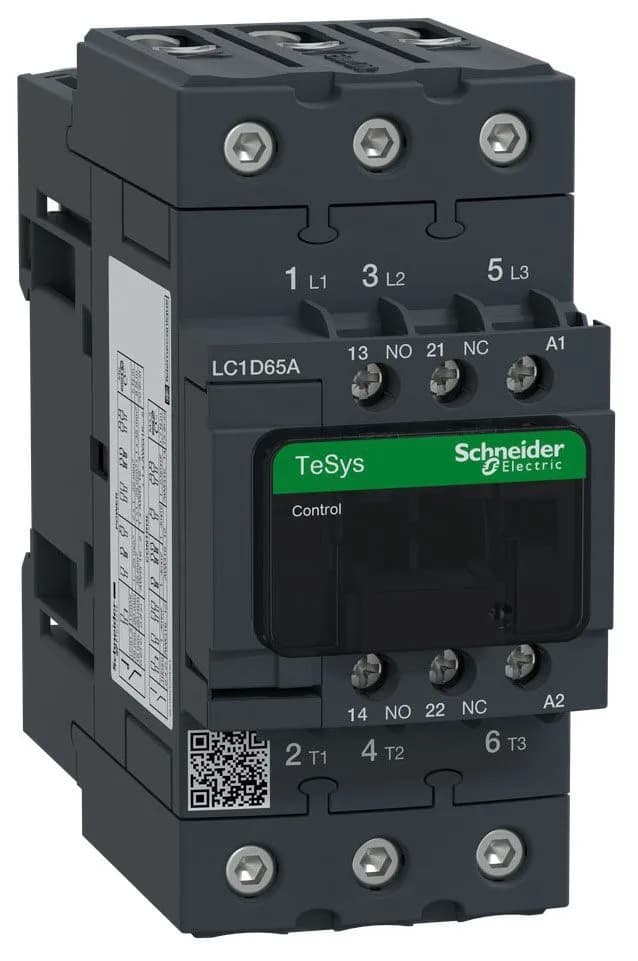
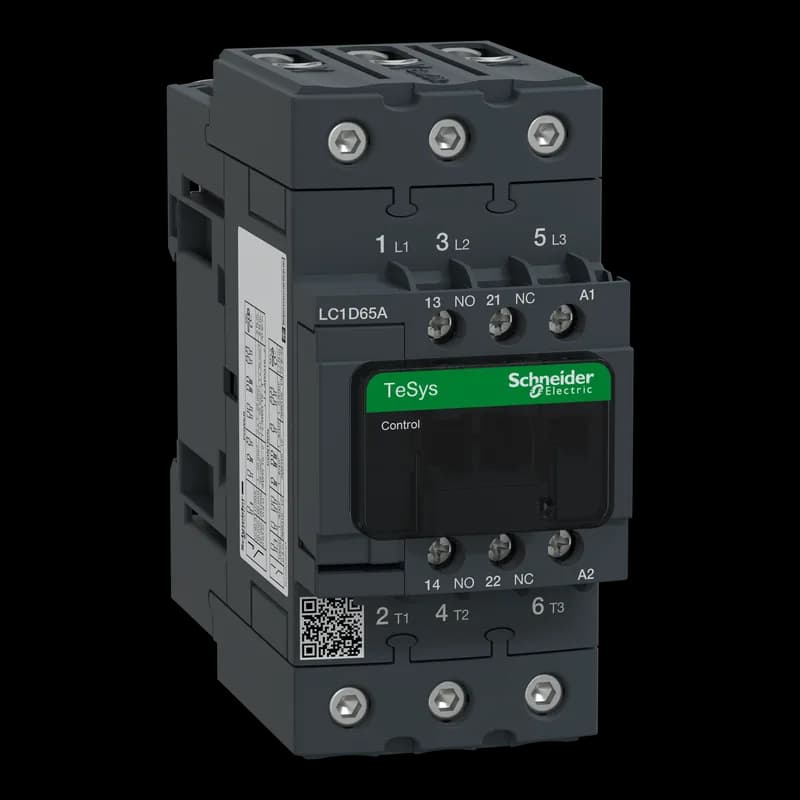
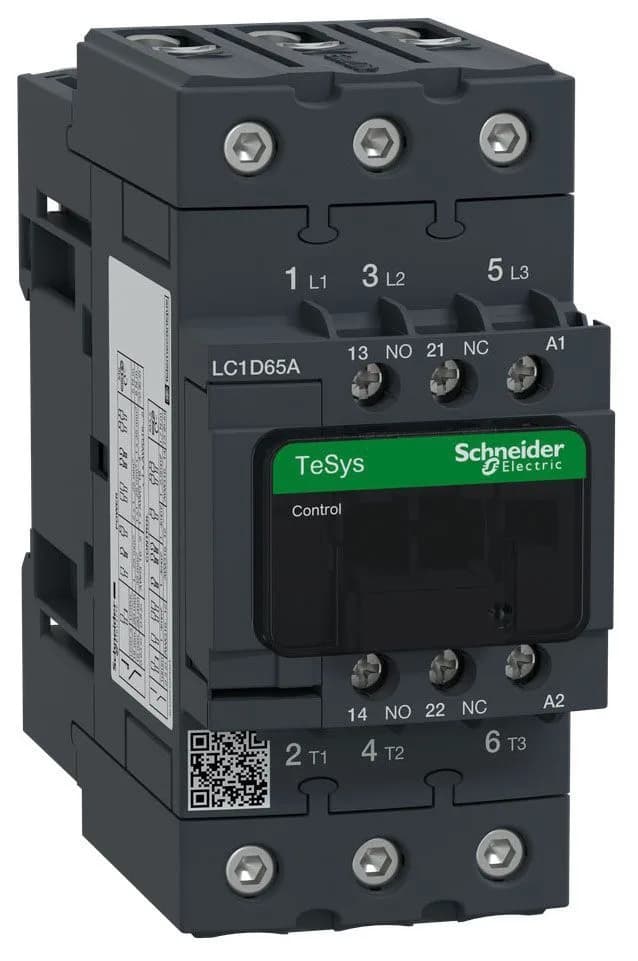
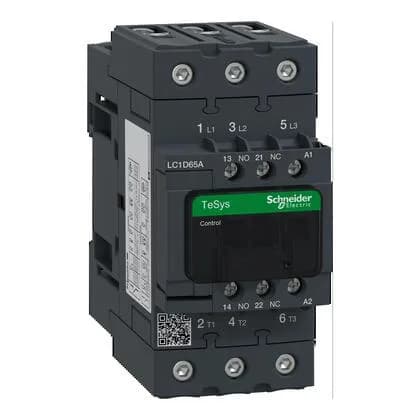
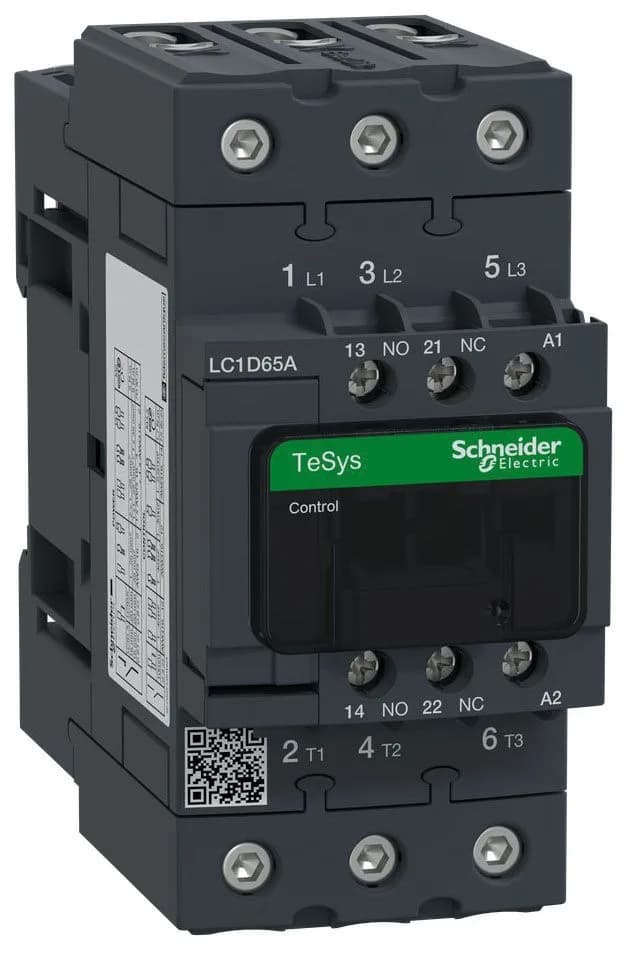
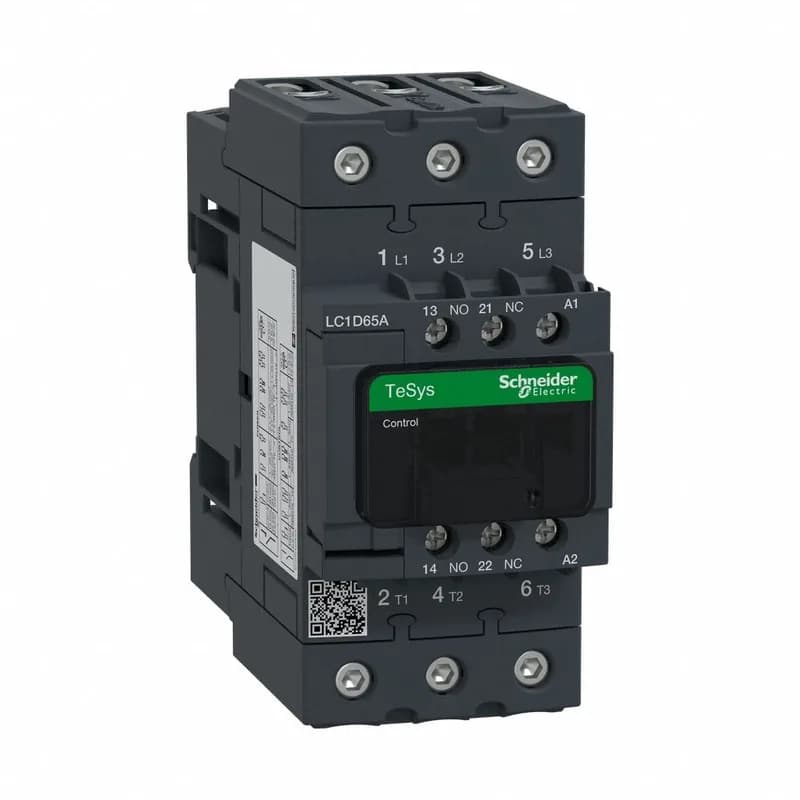
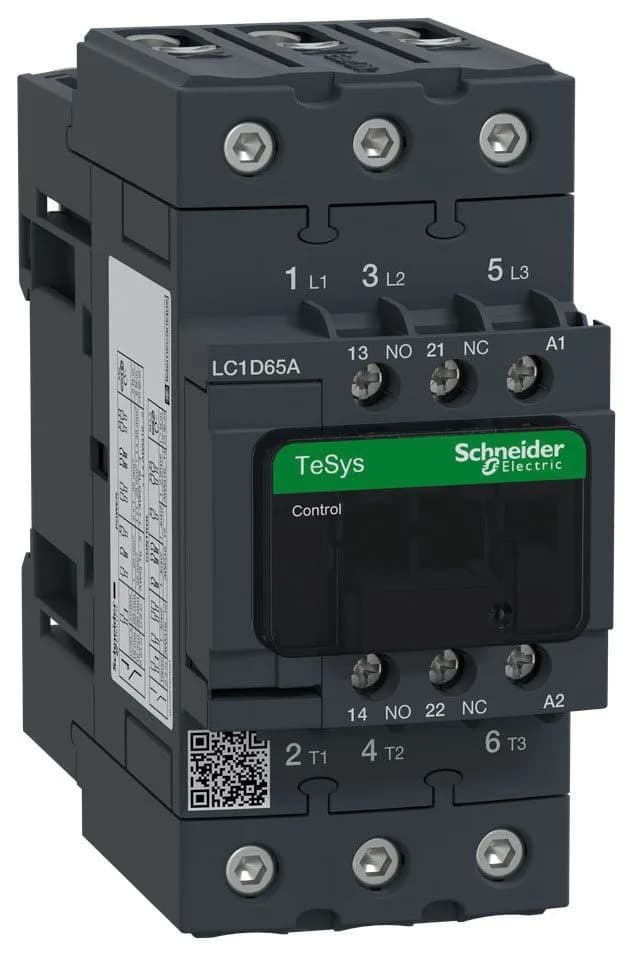
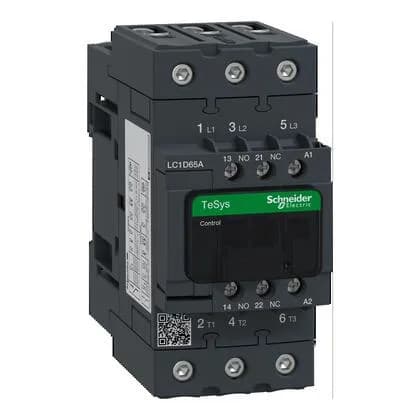
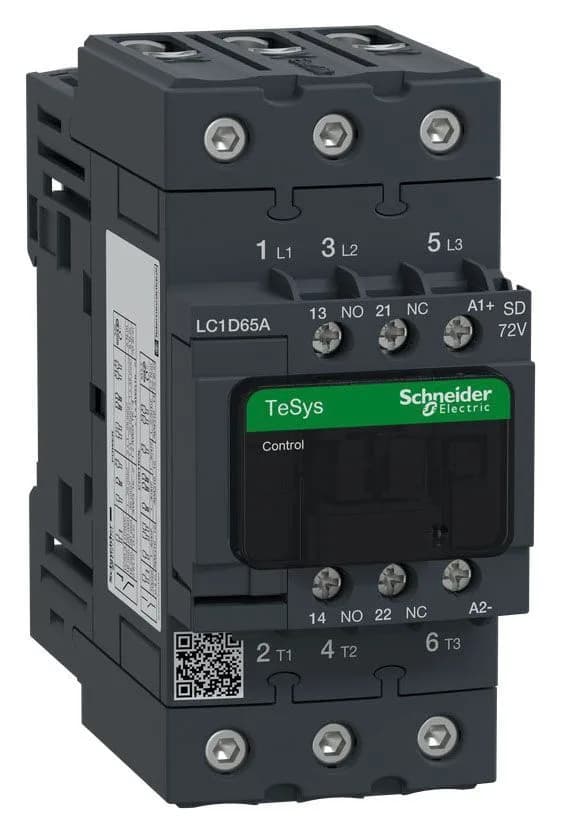
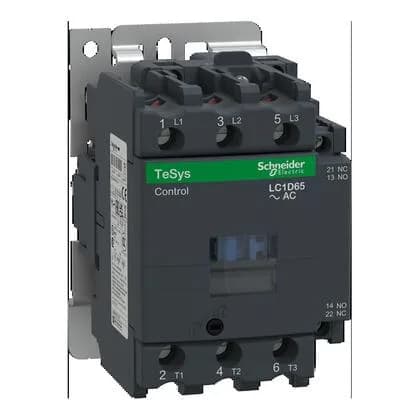
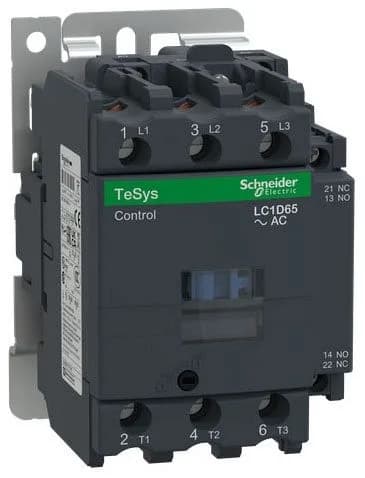
LC1D65A6FD
Schneider Electric
IP20Resistive load Motor control60 °C
Ref. price$489.00
Lead time on requestGet quote
2012 variants · Schneider Electric
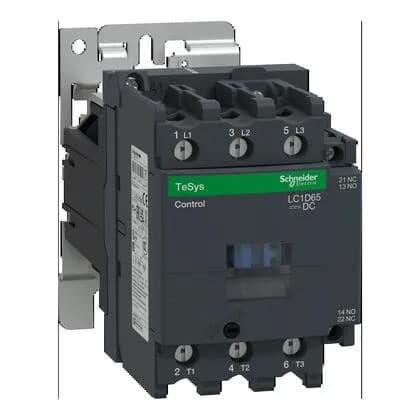
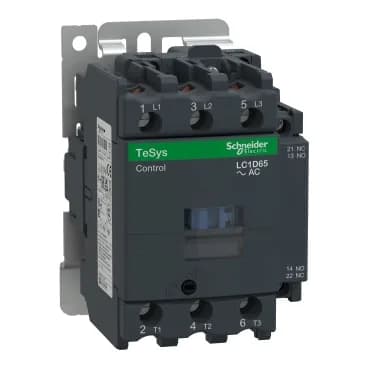
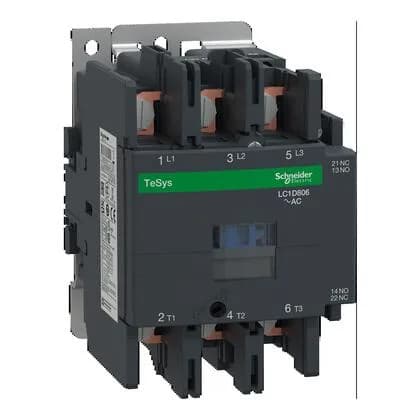
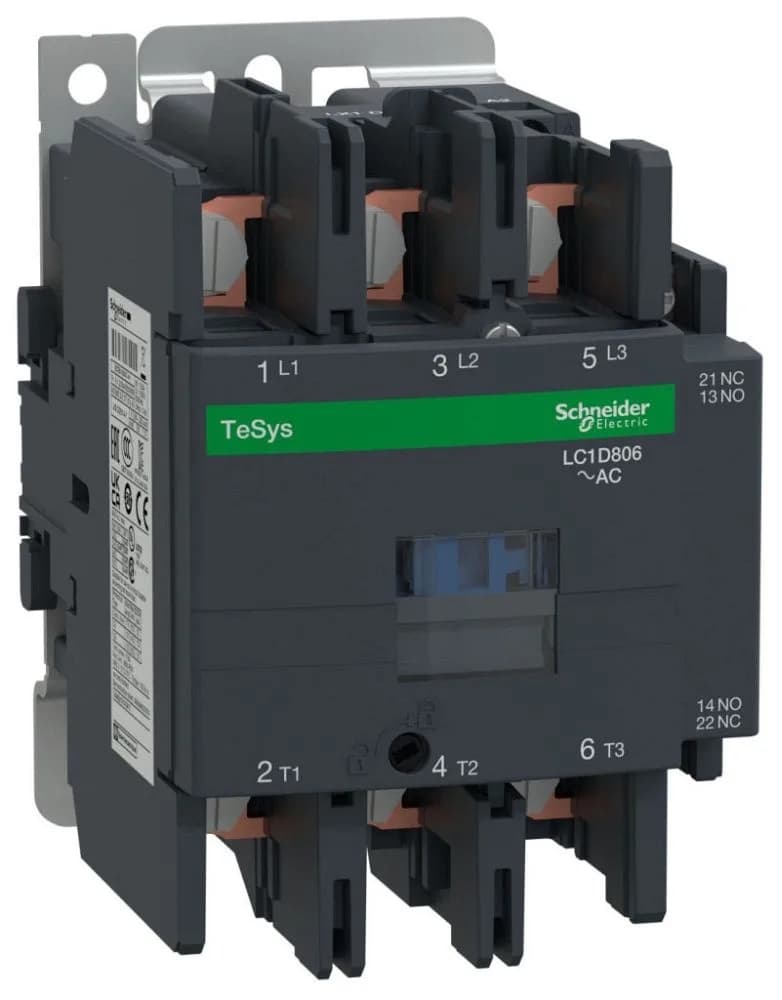
The TeSys D line is Schneider Electric's mainstream IEC contactor family for switching motors and resistive loads in industrial control panels. If you have ever opened a factory motor control cabinet, you have probably seen the familiar grey-and-black TeSys D housing. These contactors handle three-phase motor starting and stopping at voltages up to 690 V, covering the bulk of standard induction motor applications from fractional horsepower conveyors up to 75 kW drives.
What sets the TeSys D apart from the older LC1-F (TeSys F) series is its coil ecosystem. TeSys D contactors share coils and accessories across the entire 9–150 A frame range — you stock fewer spare coils and the coil replacement procedure is the same whether you are servicing a 9 A unit on a small pump or an 80 A unit on a crusher motor. Compared to the TeSys K miniature contactor range (which tops out at 12 A and uses a different coil form factor), the TeSys D is the first step into full-size industrial loads.
TeSys D contactors appear across a range of machinery types:
| Parameter | LC1D09–LC1D18 | LC1D25–LC1D38 | LC1D40–LC1D65 | LC1D80–LC1D150 |
|---|---|---|---|---|
| Rated operational current (AC-3, 440 V) | 9–18 A | 25–38 A | 40–65 A | 80–150 A |
| Max motor power (AC-3, 400 V) | 4–7.5 kW | 11–18.5 kW | 18.5–30 kW | 37–75 kW |
| Coil voltage options | 24 V DC, 24–230 V AC | 24 V DC, 24–230 V AC | 24 V DC, 24–230 V AC | 24 V DC, 24–230 V AC (some frames 48 V DC) |
| Auxiliary contact configuration | 1 NO + 1 NC (built-in) | 1 NO + 1 NC (built-in) | 1 NO + 1 NC (built-in) | 1 NO + 1 NC (built-in, LC1D80–D95); 2 NO + 2 NC (LC1D115–D150) |
| Mechanical life (operations) | 10 million | 10 million | 8 million | 5 million (D115–D150: 4 million) |
| Electrical life (AC-3, ops) | 1.6 million | 1.4 million | 1.2 million | 800,000 |
| Mounting | 35 mm DIN rail or screw | 35 mm DIN rail or screw | 35 mm DIN rail or screw | Screw only (D80 and above) |
All frames carry IEC 60947-4-1 and can be supplied with a wide range of add-on blocks: front-mount auxiliary contacts (LADN / LADT), mechanical interlocks for reversing pairs (LAD9R1 / LAD9V2), surge suppressors (LAD4RCU / LAD4V), and electronic timers (LADT0 through LADT4).
First, confirm your load category. Read the motor nameplate. If you are switching a squirrel-cage induction motor with infrequent starts — the standard case — look at the AC-3 rating column above. If you are switching resistive heaters, use the AC-1 rating, which is significantly higher (an LC1D09 rated at 9 A for AC-3 handles 25 A for AC-1). For plugging, inching, or frequent reversing duty, you need the AC-4 rating — expect to derate by roughly 50% from AC-3.
Second, pin down your coil voltage. The most common field retrofit mistake is ordering a 230 V AC coil for a panel wired for 24 V DC control. Schneider ships the TeSys D with coils in 24 V DC, 24 V AC, 48 V AC, 110 V AC, 120 V AC, 220 V AC, 230 V AC, and 415 V AC. The 24 V DC variant (suffix "BD" on the part number, e.g., LC1D09BD) is the default for PLC-driven panels because you can drive it directly from a digital output card without an interposing relay.
Third, size your overload relay. TeSys D contactors mechanically mate with the LRD series thermal overload relays and the LR9D electronic overloads. For a motor drawing 12 A FLC, you would pair an LC1D18 contactor with an LRD16 (9–13 A adjustment range) or an LRD21 (12–18 A). Leave headroom — running an overload at the very top of its adjustment range reduces trip accuracy.
Fourth, check the environment. TeSys D contactors are rated for 0–60 °C ambient at nominal current. Above 40 °C continuous, apply a 1% derate per degree Celsius. At altitudes above 3000 m, the reduced air density affects arc quenching — derate the AC-3 current by roughly 1% per 100 m above 3000 m.
TeSys D part numbers follow a predictable pattern: LC1-D where <size> is the AC-3 current and <coil> is the voltage suffix. Examples:
The "P7" suffix = 230 V AC; "BD" = 24 V DC; "B7" = 24 V AC; "F7" = 110 V AC. Some distributors list the coil voltage in brackets after the part number — double-check the suffix before purchasing, because returns on custom-coil contactors are rarely accepted.
TeSys D is a volume commodity line — Schneider and its authorised distributors (RS, Farnell, Mouser, Digi-Key) carry deep stock on the common sizes (9–38 A, 24 V DC and 230 V AC coils). Lead times on standard configurations are typically same-day to three days in most regions. The 65 A and above frames, and non-standard coils (48 V DC, 415 V AC), can slip to two to four weeks during peak manufacturing seasons. If you are buying in quantity for panel builds, ask your distributor about the TeSys D multi-pack cartons — Schneider bundles the 9 A and 12 A sizes in boxes of 10 at a discount versus individual units. Counterfeits of TeSys D are a genuine problem in some markets; buy only from authorised channels and verify the Schneider holographic label and QR traceability code on the side of the contactor body.
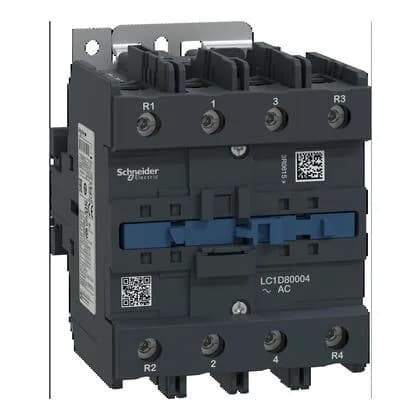
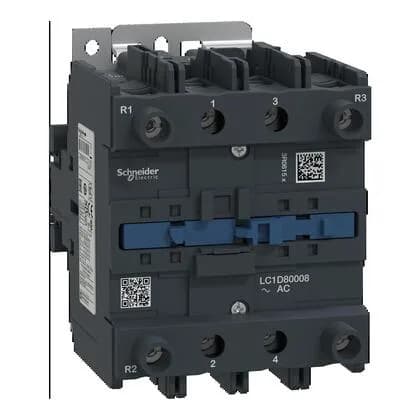
The Schneider Electric TeSys D Contactor series groups 2012 related part numbers, each listed with full specifications, a datasheet where available, and an RFQ option. The listed variants share a common main product or component type of Contactor. Variants differ by application, depth and height, so you can match the exact application your application requires using the selection guide below. The range mixes active and legacy part numbers, so you can source both current TeSys D Contactor variants and discontinued ones from a single page.
| Parameter | LC1D65008B7 | LC1D65008D7 | LC1D65008F7 | LC1D65008G6 | LC1D65008M7 | LC1D65008P7 |
|---|---|---|---|---|---|---|
| Application | Resistive load | Resistive load | Resistive load | Resistive load | Resistive load | Resistive load |
| Depth | 4.9 in (125 mm) | 4.9 in (125 mm) | 4.9 in (125 mm) | 4.9 in (125 mm) | 4.9 in (125 mm) | 4.9 in (125 mm) |
| Height | 5 in (127 mm) | 5 in (127 mm) | 5 in (127 mm) | 5 in (127 mm) | 5 in (127 mm) | 5 in (127 mm) |
| Utilization category | AC-1 | AC-1 | AC-1 | AC-1 | AC-1 | AC-1 |
| Width | 3.3 in (85 mm) | 3.3 in (85 mm) | 3.3 in (85 mm) | 3.3 in (85 mm) | 3.3 in (85 mm) | 3.3 in (85 mm) |
| Electrical life cycles | 1.4 Mcycles 80 A AC-1 <= 440 V | 1.4 Mcycles 80 A AC-1 <= 440 V | 1.4 Mcycles 80 A AC-1 <= 440 V | 1.4 Mcycles 80 A AC-1 <= 440 V | 1.4 Mcycles 80 A AC-1 <= 440 V | 1.4 Mcycles 80 A AC-1 <= 440 V |
| IP rating | IP20 | IP20 | IP20 | IP20 | IP20 | IP20 |
| Mechanical life cycles | 6 Mcycles | 6 Mcycles | 6 Mcycles | 6 Mcycles | 6 Mcycles | 6 Mcycles |
Request a quote on any TeSys D Contactor part number and we confirm price, availability and lead time per line — including end-of-life and allocation-constrained variants.
Schneider Electric
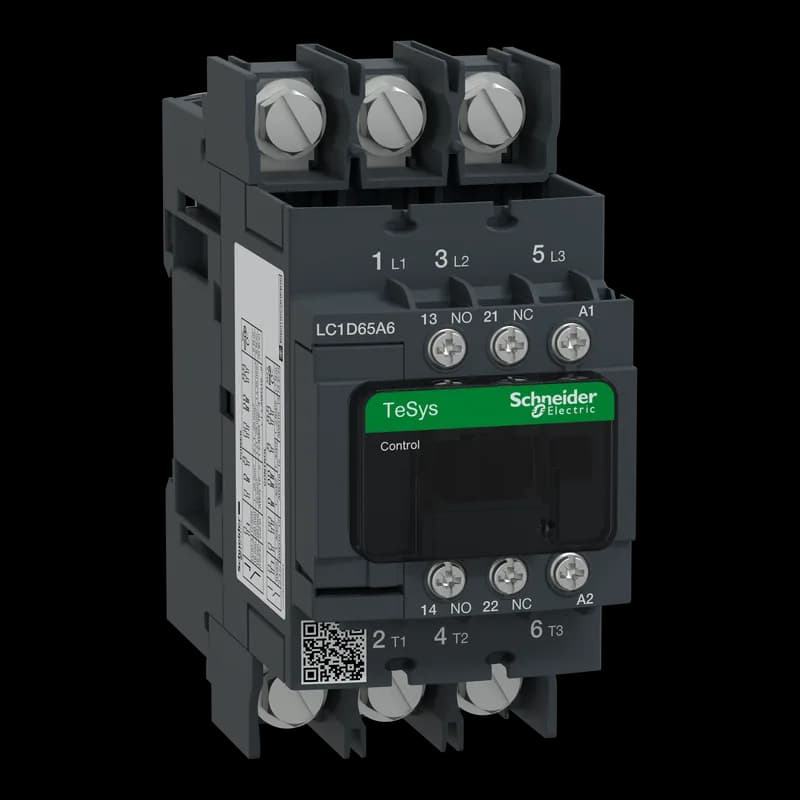
Schneider Electric
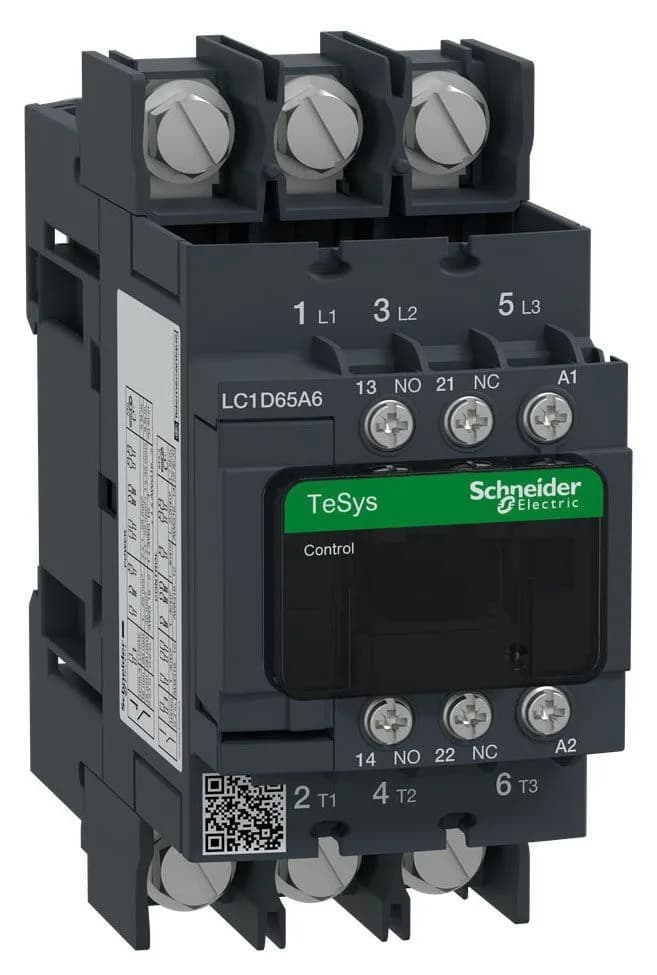
Schneider Electric
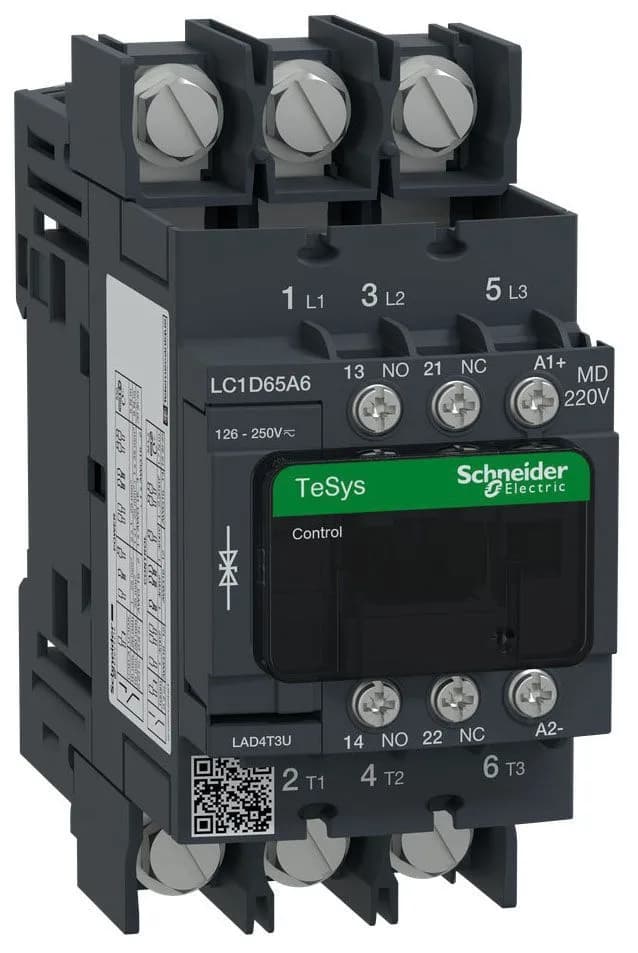
Schneider Electric
Schneider Electric
Schneider Electric
Schneider Electric
Schneider Electric
Schneider Electric
Schneider Electric
Schneider Electric
Schneider Electric
Schneider Electric
Schneider Electric
Schneider Electric
Schneider Electric
Schneider Electric
Schneider Electric
Schneider Electric
Schneider Electric
Schneider Electric
Schneider Electric
Schneider Electric
Schneider Electric
Schneider Electric
Schneider Electric
Schneider Electric
Schneider Electric
Schneider Electric
Schneider Electric
Schneider Electric
Schneider Electric