What it does on the drive side
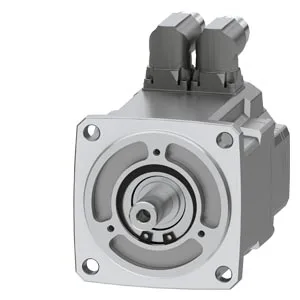
The Siemens 1FK2104-4AF10-0SB0 is a SIMOTICS S-1FK2 HD servo motor in the 1FK2 family built for SINAMICS S120 drives, sized for 0.4 kW at nN=3000 rpm on a 380-480 V DC link and 0.2 kW at nN=1500 rpm on 200-240 V, with a stall torque M0 of 1.27 Nm and an integrated holding brake for vertical-axis or gravity-loaded positioning. Feedback and comms are drive-native: a single-turn 22-bit absolute encoder (AS22DQC) over a DRIVE-CLiQ plug M17, paired with a size M17 power connector, so commissioning is a single digital cable run back to the SINAMICS S120 — no third-party resolver or external encoder box. Mechanical integration is on the standard 1FK2 HD footprint: cylindrical shaft D19 x 40 mm, IP64 housing protection, so it tolerates dust and splash typical of factory cabinets and machine interiors but is not sealed for direct washdown.
Ratings that drive the BOM fit
0.4 kW at nN=3000 rpm (380-480 V) is the headline rating and it sets the drive-side sizing — pair it with the SINAMICS S120 line module on the higher DC-link voltage for full continuous torque; on the 200-240 V window the same winding delivers 0.2 kW at nN=1500 rpm, useful where the cabinet is fed from a 230 V drive line. M0 = 1.27 Nm is the stall torque figure — the load-burst ceiling for accel/decel profiles — and combined with the holding brake, the motor holds position with the drive de-energised, which is what you want on vertical axes and tool-change positions where drift after a stop is unacceptable. The 22-bit single-turn absolute encoder AS22DQC gives 4,194,304 positions per shaft revolution, enough resolution for high-precision indexing without an external gearbox on most packaging and small-format handling machines.
Lifecycle, compliance and order class
The lifecycle stage is current and product status is Active, so the motor is sourced new from the factory channel against the BOM line — quoted to order, with no stock-holding or same-day claim attached. Product class C marks this as a make-to-order item: it is manufactured / produced to order and cannot be reused, re-utilised or returned against credit, so the typical path is to specify the quantity, confirm the lead at RFQ, and accept the make-to-order terms rather than treating it as a stocked consumable.