What this motor is built to do
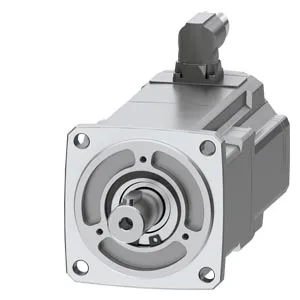
The Siemens 1FK2104-4AF11-1SA0 is a SIMOTICS S-1FK2 HD servo motor sized to a 0.4 kW continuous rating at nN=3000 rpm on a 380-480 V supply, with a parallel 0.2 kW / 1500 rpm rating on 200-240 V — so the same frame ships into both 230 V-class and 400 V-class SINAMICS S210 cabinets without a variant split. It is part of the 1FK2 servomotor family, which is the matched low-inertia motor line for the SINAMICS S210 drive platform. Holding brake is fitted and the body carries an IP65 rating with degree-of-protection coverage at the shaft seal — meaning the motor tolerates the coolant splash and panel-cutout dust typical of a machine-tool or packaging-line cabinet, and the brake holds the axis at standstill when the drive is de-energised. The shaft is D19x40 mm with a feather key, the encoder is an absolute single-turn 22-bit (AS22DQC) for high-resolution position feedback within one revolution, and the power/signal connector is plug size M17, rotatable — useful when the cabinet harness drops in from an awkward angle.
Catalog identifiers and product class
Listed under Group Code R220 and Product Group 9021 in the Siemens ordering system — both are SAP-level identifiers used by procurement to route the line on the punch-out catalog rather than engineering-level ratings. The line carries product class C: manufactured/produced to order, non-returnable, non-reusable — meaning a PO cannot be cancelled or credited once the build slot opens. Treat it like any other made-to-order Siemens servo: confirm the BOM line, the encoder variant, and the connector orientation before release.
Lifecycle status and documentation pack
These are the standard Siemens substance-compliance statements for a current-designation motor. Packaging is one piece per shipper at 452.00 x 250.00 x 267.00 mm — single-unit pack, no multi-pack discount built into the order code.
Sourcing posture for the BOM line
Because the product class is built-to-order, an indirect-spend route via the punch-out catalog is the cleanest path: the line item rides the controlled supplier, the PO hits the standard cost-per-PO envelope, and the build-slot lead time is quoted at the time the RFQ is released.