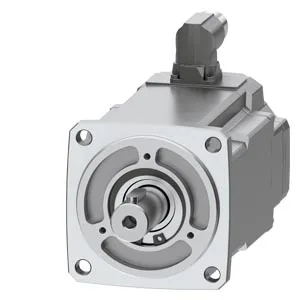
Servo motor for the SINAMICS S210 drive line
The 1FK2204-5AK00-1SA0 is a SIMOTICS S-1FK2 CT servo motor out of the 1FK2 family, designed to pair with the SINAMICS S210 servo drive system. Stall torque M0 is 2.4 Nm; rated power is 0.57 kW at nN 6000 rpm on a 380–480 V bus, or 0.75 kW at nN 3000 rpm on a 200–240 V bus. The dual power point tells you the same frame is released for both the EU-style 230 V three-phase and the global 400 V class — match the constant-power curve to your bus before sizing. Feedback is an AS22DQC single-turn 22-bit absolute encoder with an OCC (One Cable Connection) interface, terminated through a rotatable M17 plug. The OCC interface collapses the encoder and power conductors into a single hybrid cable to the S210 — one cable run instead of two between drive and motor, which is the practical reason the S210/1FK2 pairing is specified into compact machines.
Mechanical fit, shaft, and ingress
Shaft is D19 x 40 mm with a feather key — a short, keyed stub suited to direct-coupled gearboxes or pinions where axial play and concentricity matter. Degree of protection is IP64, meaning dust-tight and protected against splashing water from any direction; this is sufficient for shop-floor cabinets and machine interiors, not for washdown or outdoor duty where IP65 or higher is normally required. Product class is C — built to order, non-returnable, non-reusable. On a BOM line, that means a cancellation after release is a real cost, not a stock-credit. The shipping carton is 452.00 x 250.00 x 267.00 mm at one piece per pack.
Lifecycle, compliance, and the S210 context
Lifecycle stage is current and the product is active. RoHS compliance is declared since 01-07-06, and REACH Art. 33 duty-to-inform is flagged via the standard Reach Information notice. The motor is grouped under Siemens Group Code R220 / Product Group 9021. For a panel builder or system integrator specifying into the SINAMICS S210 line, the 1FK2204-5AK00-1SA0 sits in the compact low-inertia end of that family — sized for fast point-to-point axes and small-format machines rather than heavy-duty main spindles.