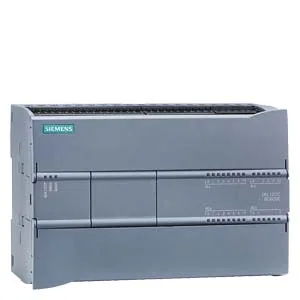
CPU 1217C, DC/DC/DC — what the catalog code is buying you
The Siemens 6ES7217-1AG40-0XB0 is a SIMATIC S7-1200 family CPU — the 1217C class — running on a 24 V DC supply, sized at 150 × 100 × 75 mm for DIN-rail mounting in a standard subpanel. It executes LAD, FBD, and SCL natively and supports DCP for PROFINET device addressing, which is the workflow TIA Portal uses to discover the station on the network. On the IT side, the CPU speaks PROFINET, Modbus TCP, TCP/IP, UDP, SNMP, and LLDP, and ships with an OPC UA Server role, so a SCADA package can consume the tag namespace directly without a separate gateway — useful when the panel has to hand data up to a plant historian. PROFIBUS is not on the CPU itself; the catalog line spells out that adding PROFIBUS means a CM 1243-5 (master) or CM 1242-5 (slave) sits beside the CPU. PROFIsafe is not supported, IRT is not supported, and DHCP is not supported — the addressing story is static/DCP, which is the standard S7-1200 posture.
The connection budget is the real spec, not the protocol list
Yes/no on each protocol is only the front of the card. The figure that actually decides whether your SCADA, HMI, and recipe mix fits is the connection budget: 4 PG / 12 HMI / 8 S7 / 8 open user / 2 web / 0 OPC UA connections are reserved by the firmware, scaling to maxima of 4 PG, 18 HMI, 14 S7, 14 user, 30 web, and 10 OPC UA, with a hard ceiling of 64 total connections on the CPU. That reserved-versus-maximum split is the procurement-relevant number: a panel expected to land 18 HMIs, 14 S7 partners, 14 open-user sockets, and 10 OPC UA clients is sitting exactly at the 64-connection ceiling, with no headroom for an unplanned web dashboard or a second PG on the bench. Plan the connection count before you plan the protocol list.
Electrical envelope and ambient limits
The supply input is 24 V DC with a minimum of L+ minus 4 V DC at the terminal — that is the working voltage the CPU needs at its own clamp, after voltage drop in the cabinet wiring, so 24 V at the PSU is not the same as 24 V at the CPU. Onboard I/O is presented as isolated, with voltage present detection and adjustable ranges covering 0 to 10 V and 0 to 20 mA on the analog side, plus forcing on the digital side for bench commissioning without a live process. The ERROR and MAINT LEDs are the visible status surface during commissioning, and PROFINET diagnostics ride on the same channel via the LLDP/DCP stack.
What the wireman and commissioning engineer need on the bench
Onboard I/O and the standard SIMATIC variable set — inputs/outputs, memory bits, data blocks, distributed I/O, timers, counters — are all directly addressable, so the FAT can exercise the I/O map and the timer/counter logic without extra engineering. Presence detection on the I/O channels lets the panel builder confirm a missing module at power-up instead of chasing a wiring fault.
Compliance floor for the storeroom gate
Compliance on record is cULus and CE mark. That is the floor for a North American control panel; anything beyond that — RoHS, REACH, IEC type-2 — is not asserted here and would have to be pulled from the manufacturer's compliance pack separately.