What the 2.4 Nm / 6000 rpm rating actually means on the bench
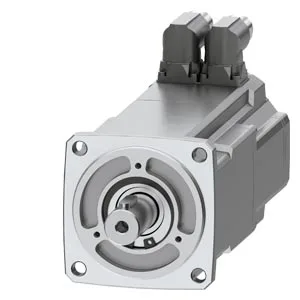
The 1FK2204-5AK10-1MB0 is a SIMOTICS S-1FK2 CT servo in the compact low-inertia family for SINAMICS S120 — the continuous stall torque is 2.4 Nm with PN = 0.57 kW at nN = 6000 rpm on a 380–480 V rail and PN = 0.75 kW at nN = 3000 rpm on a 200–240 V rail, which is the dual-rail rating curve the drive firmware has to be configured against before the first move command. Holding brake is integrated on this build, the absolute encoder is AM22DQC at 22-bit single-turn plus 12-bit multiturn — that resolution is what lets the position loop close tight without a homing routine after every power cycle, and it shows up on the SINAMICS topology as a DRIVE-CLiQ node on the M17 connector rather than a third-party feedback cable. The 8 kHz / 62.5 µs current-loop sample rate is the part's load-bearing figure for dynamic performance — match the inertia first, then push the velocity loop bandwidth against that clock, because at this rating the current loop is sampling faster than most mid-range servos in the same frame size.
Mechanical interface and what IP64 actually seals
Output shaft is D19 × 40 mm with feather key, power connector is size M17 and the DRIVE-CLiQ feedback connector is M17 — both are rotatable on the housing so the cable dress can be set after the motor is bolted down without binding the conductors against the flange. IP64 here is dust-tight and protected against splashing water from any direction; it is sufficient for an enclosure-mounted axis or a clean industrial cabinet, but it is not the washdown rating (IP65 or higher) that a food-and-bev or outdoor skid would need — confirm the surrounding environment before specifying it for a wet zone.
Build-to-order class and what that does to your BOM line
Product class is C — built to order with no return credit, one piece per quantity unit, packed 1 per shipper at 452 × 250 × 267 mm; group code R220 and product group 9021 are the Siemens internal identifiers a procurement system uses to route the line correctly through SAP. Lifecycle stage is current and the part is active in the Siemens catalog — for volume, build a quoted-to-order RFQ against your panel quantity and let the supplier confirm lead time per batch, because a class-C servo does not sit on a finished-goods shelf and the production slot drives the delivery date.