What this order code is
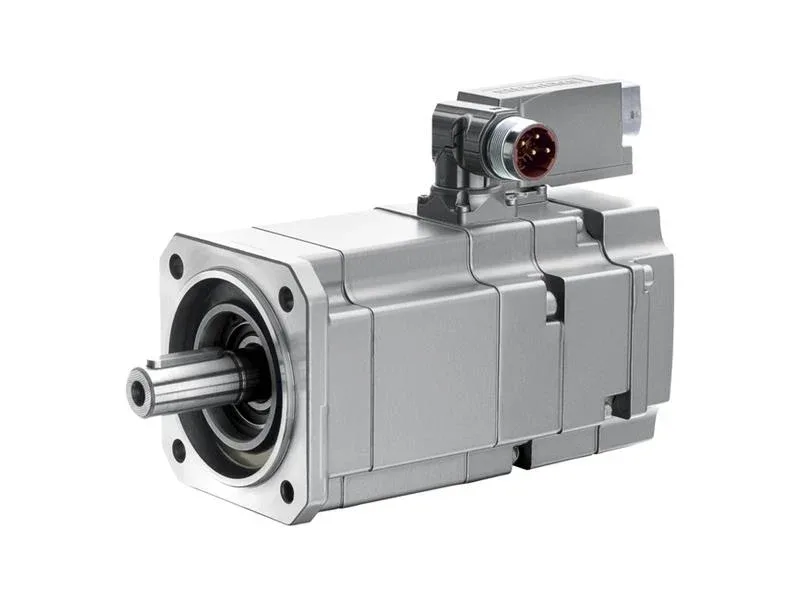
The 1FK7044-7AH71-1...: The Siemens 1FK7044-7AH71-1 is the catalogue string for a SIMOTICS S 1FK7 High Dynamic synchronous servo motor, sold as a spare-part line item rather than a configured new assembly (cites:). It is the small-frame end of the High Dynamic family — 4.0 Nm of continuous stall torque at the 100 K thermal class, 4500 rpm rated speed, and 1.41 kW shaft power on natural cooling (cites:). For a junior wiring this up for the first time, the part number tells the whole story once you can read it: the 1FK7 family, the 4-pole stack length, the encoder option, and the connector variant — all of those shape which SINAMICS drive firmware block it slots into. Mechanically it is an IM B5 flange-mount motor with a power/signal connector that swings through 270° to clear the cable gland on the machine side (cites:). That rotatable plug matters in retrofit cabinets where the existing cable exit was drilled for the original motor body — being able to clock the connector saves a glanded penetration and a flex conduit run.
4.0 Nm of stall torque in the 100 K winding thermal class is the steady figure the drive's torque limit block should be set against, not the peak — the High Dynamic family publishes a separate peak figure for S1/S2 cycles, and 100 K is the steady-state envelope that the naturally-cooled housing can hold continuously without tripping the winding temperature model (cites:). 4500 rpm is the rated speed the encoder resolution and resolver feedback were sized for, so any fieldbus homing routine already in the machine's code will land without re-parameterising the axis scaling (cites:). 1.41 kW on natural cooling — no blower, no forced-air kit — is the figure that matters for cabinet layout: the heat load dumped into the cabinet interior is the 1.41 kW minus shaft work plus drive losses, and a sealed cabinet with no extraction fan will run the servo above its 100 K limit over time (cites:). In practice that means if this motor is being dropped into an old enclosure, the panel side either already has forced ventilation or it needs one before the motor sees a duty cycle.
Lifecycle posture for a spare
The listing records as eol_hot for this order code, so it is being serviced as a replacement spare rather than booked against new machine orders (cites:). With the SIMOTICS S line, an eol_hot flag means the production window has closed but the manufacturer is still authorising spare-part distribution — last-time-buy cutoff dates vary by region, and the only honest way to keep a critical cell alive through the transition is to size the on-shelf spares against the mean time-to-failure of the population in service, not against the catalogue lead-time promise. Because this is the spare-part variant of the catalogue code, the practical implication for procurement is straightforward: the order code itself remains the supported way to source a replacement, but pricing tracks the shrinking production run — independent distribution handles the gap when the authorised channel has rationed stock (cites:,). A junior specifying this for the first time should treat the eol_hot flag as a one-way signal to start logging the installed base rather than as a green light to defer restocking.
On a panel and in a machine
The 1FK7 High Dynamic family is the compact dynamic-response servo line — typical duty is high-acceleration rotary axes on packaging, converting, and small-parts handling where the cycle rate is more binding than the steady torque envelope (cites:,). The B5 flange and rotatable connector make it straightforward to mount on a gearbox input or a direct-drive pulley when the cabinet entry geometry permits it, and the resolver feedback variant typical of this frame plays natively with the SINAMICS S120 drive family already in most retrofitted cells (cites:).