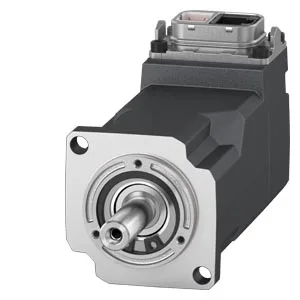
50 W at 0.16 Nm — small-format servo on the SINAMICS S200
The 1FL2102-2AG11-0HC0 is a SIMOTICS 1FL2 low-inertia servo sized at 0.16 Nm rated/stall torque with 50 W continuous power at 3000 rpm, fed from a 200 V 3AC supply and wired to a SINAMICS S200 drive — the 20 mm shaft height and 17-bit absolute encoder make it the bench-scale end of that drive family rather than a general-purpose servo. Holding brake and IP65 with oil seal are fitted as standard, so the unit drops into vertical-axis or light-conveyor cells where the shaft has to hold position with the drive powered down, and the sealing is the wet-end duty rating (oil mist, coolant splash) rather than full submergence.
Spec decoding — ratings the panel builder actually keys off
Pn=50 W and Nn=3000 rpm at 200 V 3AC sets the drive sizing — a SINAMICS S200 axis block is matched for this 1FL2 frame, not cross-wired to a 400 V drive from a higher-output 1FL2 variant. M0=0.16 Nm equals Mn=0.16 Nm, meaning the rated torque and stall torque are the same figure — the motor delivers rated torque from zero speed, which is the defining trait of a low-inertia servomotor and what makes it suitable for fast point-to-point moves rather than constant-torque loads. Plain shaft, tolerance N, with a hybrid connector and AS 17-bit absolute encoder — the encoder type is fixed by the order code suffix, so the drive auto-commissioning expects absolute position on first power-up rather than running a homing routine.
Ordering reality — made-to-order, non-returnable, RoHS since 2018
Product class C flags the 1FL2102-2AG11-0HC0 as made to order — it is built per the BOM and cannot be returned against credit, so spare-parts planning has to assume configured lead time rather than shelf-pull. Lifecycle status reads current on the Siemens record, RoHS compliance runs since 01-01-18, and REACH Art. 33 disclosure applies — the documentation set a quality-control review will look for is the standard SIMOTICS/SINAMICS bundle, not anything beyond that. Group Code R220 / Product Group X0DJ are the internal Siemens planning keys the procurement system uses; they do not change the part's function but they do drive the factory's build schedule slot and the price-break ladder.