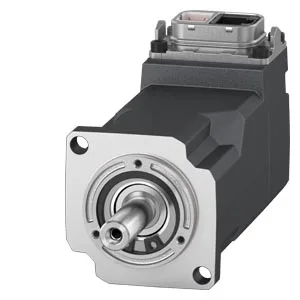
What this little servo actually delivers
The Siemens 1FL2102-4AF11-0MC0 is a SIMOTICS S-1FL2 low-inertia servomotor sized at 400 V 3AC, Pn 100 W, Nn 3000 rpm, with standstill and rated torque both at 0.32 Nm — meaning a small-format motor tuned for fast, repetitive moves where holding torque and inertia both stay modest. It carries a 21-bit single-turn encoder (AM21bit), a plain shaft with tolerance N, and an integrated holding brake — the standard configuration for vertical or gravity-loaded axes where the brake has to hold position when the drive is disabled. The IP65 rating with oil seal means the body and shaft exit are sealed for plant environments where coolant mist and cutting fluid are present, not full washdown submersion.
Why it pairs with the SINAMICS S200
This motor is catalogued under the 1FL2 servomotor family for SINAMICS S200 — the S200 servo drive is the matched electronics side, and the hybrid connector AM21it-style interface is wired to that drive rather than a third-party controller. A 20 mm shaft height, 0.32 Nm continuous torque, and 100 W power class puts this in the very-small-format feeder / indexer end of the SINAMICS S200 line — label applicators, small indexing tables, light conveyor diverters, and short-stroke pick-and-place gantries are the natural fit, not the heavy-payload end of the line.
Lifecycle, sourcing reality, and the BOM angle
The product class is 'made to order, non-returnable' and ships as a single piece in a 315 x 182 x 172 mm pack — meaning there is no shelf stock at the factory, every order is built to the order, and a returned unit cannot be credited back into the channel. For a buyer, that production rule plus an active lifecycle stage translates into: confirm the order code on the RFQ, plan the lead time against a build slot, and treat this as a sourced-to-order line rather than a next-day shelf pull.
Compliance and trade posture for import paperwork
Export control classification reads AL:N / ECCN:N, which is the no-license-required default — a free export lane for most destinations, with no dual-use flag triggering extra customs documentation.