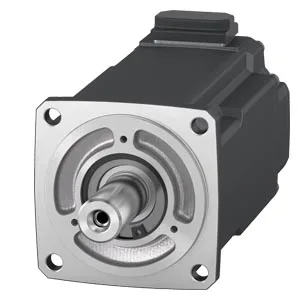
SIMOTICS S-1FL2 servo motor — matched to SINAMICS S200
The Siemens 1FL2104-2AG00-1HC0 is a SIMOTICS S-1FL2 low-inertia servo motor in the 40 mm shaft-height frame, rated 0.75 kW at 200 V three-phase AC with a 3000 rpm nominal speed and 2.4 Nm rated torque (M0 and Mn are identical at 2.4 Nm, so there is no torque reserve above the continuous rating). It ships with a hybrid connector carrying the AS17bit absolute encoder — 17 bits of single-turn resolution — and mates with the SINAMICS S200 drive family as its matched inverter. No holding brake is fitted, which means the motor relies entirely on the drive for motor-side holding when stopped; any coast-to-rest after a fault or power-loss condition must be absorbed by the mechanical load or an external brake.
0.75 kW in the 40 mm frame — what the power and torque mean
Rated 0.75 kW with a 2.4 Nm continuous torque at 3000 rpm, the motor sits at the compact end of the SINAMICS S200 servo range — a common fit for packaging pick-and-place axes, small rotary tables, and feed drives on machine tools where the 40 mm shaft height constrains the coupling and coupling collar diameter. The identical M0 and Mn figures mean the rated torque is also the available starting torque; no peak-torque reserve is listed, so any short-term overload demand above 2.4 Nm must be checked against the drive's current-limit setting and the thermal time constant of the motor — a point that trips up anyone sizing a new axis by the kW label alone without cross-checking the torque-speed curve at their target bus voltage.
AS17bit absolute encoder — why the 17-bit resolution matters
The AS17bit absolute encoder reports position within one revolution without requiring a homing cycle after power-on — the controller knows the shaft angle as soon as the drive powers up. In a bottle-handling or indexing application where a homing sensor and the associated input wiring add cost and failure points, eliminating that sensor is a real BOM saving. Single-turn absolute encoders do not retain position across multiple revolutions; if the axis can travel more than one mechanical rotation, an external multi-turn reference (limit switch or home marker) is still needed for absolute positioning after a full-revolution travel event.
IP54 without oil seal — where the protection envelope sits
IP54 means the motor housing is protected against dust ingress (the first digit) and water spray from any direction (the second digit), but it carries no oil seal on the shaft feedthrough. In a food-processing or coolant-splash zone, the shaft bushing is the entry path for liquid — IP54 alone is not sufficient for washdown without an external shaft seal or bellows coupling. For a standard enclosure environment with occasional condensation or coolant mist, IP54 is adequate; for a CIP washdown cell, budget an added shaft seal or specify a motor from the same family that includes the oil seal option.
Made-to-order, active, with RoHS and REACH coverage
The product class code C confirms this motor is manufactured to each order — not pulled from a stocked shelf — so lead times track to the manufacturing schedule rather than warehouse availability. RoHS compliance dates from 1 January 2018, and REACH Article 33 duty-to-inform documentation is available from Siemens, which matters for machinery destined for EU end markets that require substance-disclosure documentation at the sub-assembly level. The packaging dimensions of 382 × 222 × 240 mm and the single-piece quantity unit mean freight classification and packing density are straightforward, but verify whether your logistics provider treats assembled servo motors with rare-earth magnets as restricted cargo for air freight.