Sizing the S-1FL2 against the cell cycle
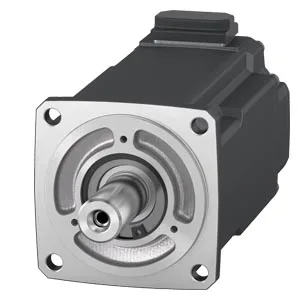
The 1FL2204-2AF01-0HC0 is a Siemens SIMOTICS S-1FL2 servomotor — shaft height 40 mm, continuous rated power 0.75 kW at 3000 rpm with a standstill and rated torque of 2.4 Nm, matched to the SINAMICS S200 drive family. That 0.75 kW / 2.4 Nm envelope slots it cleanly into the small-payload end of a palletizing or pick-and-place cell where the integrator needs a tight torque-to-inertia ratio without oversizing the drive. A hybrid cable connector, 17-bit absolute encoder, plain shaft with N tolerance, and no holding brake — so the cell designer confirms brake-holding logic upstream (Z-axis gravity hold or counterbalance) and treats the feedback as single-turn absolute. The supply input is 400 V 3AC, the same three-phase rail feeding the SINAMICS S200 converter section.
Sealing, shaft, and panel-side handling
IP65 with oil seal on the shaft — the seal is what carries the washdown rating, not just the housing. Food-and-bev lines, machine-tool coolant splash zones, and outdoor skids under a canopy are realistic deployments; the seal needs a brief run-in before it seats, and a drip loop on the hybrid cable gland keeps pooled coolant out of the connector face. The motor ships as a single piece in a 382 x 222 x 240 mm pack, Group Code R220 / Product Group X0DK, built-to-order under Product class C — non-returnable, non-reusable credit. That order class matters for spares planning: drop a motor on the shelf for a hot-swap spare rather than count on a return window if the commissioning date moves.
Compliance paperwork the buyer expects
RoHS compliance declared since 01-01-18, REACH Art. 33 candidate-list information supplied on request, and no export-control flags (AL:N / ECCN:N). That stack is what the documentation-control reviewer needs to clear the motor through incoming inspection for EU-built panels; for non-EU builds it shortens the customs paperwork to a standard commercial invoice line.
Lifecycle read and what it means for the BOM
Built-to-order under Product class C means a committed PO is the trigger for the factory build; it is not pulled from a finished-goods shelf. For a multi-axis cell that needs matched delivery dates, locking all S-1FL2 motors on a single RFQ avoids the staggered arrival that pushes a commissioning crew back to site twice.