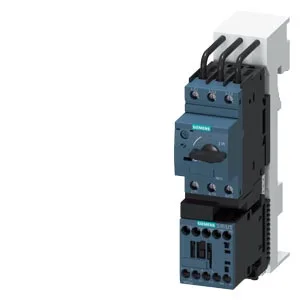
What this SIRIUS direct starter delivers
The Siemens 3RA2110-0GD15-1FB4 is a SIRIUS direct-on-line starter — a pre-assembled combination of a contactor and a thermal overload relay in one unit, sized S00. The AC-3 rating tells you it's designed for starting squirrel-cage motors and switching them off while running, not just disconnecting an idle load. That's the standard trip class for general-purpose motor starting — fast enough to prevent winding damage on a stalled rotor, but slow enough to ignore normal starting inrush.
Mounting on 60 mm busbars — panel fit
This starter is designed specifically for snapping onto 60 mm busbar systems (the supplied busbar adapter is part 8US1251-5DS10). That's a common panel layout in European-style distribution boards where the busbar runs horizontally and the starters clip on directly — no separate DIN rail needed for the power side. The mounting position is vertical only, so keep that in mind when laying out the enclosure. Dimensions are 45 mm wide, 203 mm tall, and 155 mm deep. The clearance requirements around the unit are: 50 mm upward, 20 mm forward, 10 mm downward, and 20 mm at the side — zero backward clearance needed. That's tight enough to stack multiple starters side by side on the same busbar, but the upward gap is the one to watch for cable bending radius and heat dissipation from the overload relay. Terminals on the main current circuit are screw-type, so you're looking at a standard screwdriver termination — no spring-cage tooling required. The supplied contactor is a 3RT2015-1FB41, and the link module between contactor and overload is 3RA1921-1DA00, both included in the assembly.
The rated operating current at 400 V AC-3 is 0.63 A, and the same figure applies at 480 V and 600 V AC-3. That's a low-current starter — think fractional-horsepower motors, small hydraulic pumps, or ventilation fans drawing under 0.5 kW at 400 V. The maximum operating voltage is 690 V AC-3 / AC-3e, so it's fine on 400 V or 480 V systems with headroom to spare. The short-circuit trip is magnetic (instantaneous), and the overload release is thermal bimetallic with temperature compensation from -20 to +60 °C. That compensation matters if the starter sits near a hot transformer or in a non-ventilated enclosure — the bimetallic element adjusts for ambient so it doesn't nuisance-trip on a hot day or fail to protect in a cold plant. Operating frequency is 50/60 Hz, which covers standard mains supplies worldwide.
If you're planning a production run or an MRO stock order, send the quantity and we'll quote it against authorized distribution.