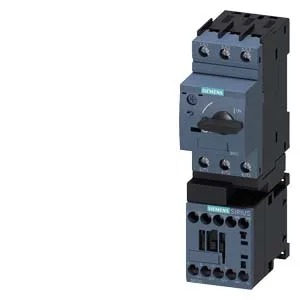
Active production — what that means for procurement
The 3RA2110-1JA16-1BB4: For a 400 V motor, this translates to roughly 4 kW or 5 hp under typical full-load current.
Panel fit and mounting constraints
Size S00 footprint: 45 mm wide, 167 mm tall, 97 mm deep. The clearance requirements are tight: 50 mm upwards, 20 mm forwards, 10 mm downwards, 20 mm at the side, and zero backwards — so the back of the unit can sit flush against the panel backplate. For a panel builder, this means the starter fits in a standard 45 mm slot on a DIN rail with no rear clearance needed, which simplifies busbar and wiring channel placement. Screw-type terminals on the main current circuit — expect to torque to the Siemens-specified value (typically 1.2–1.5 Nm for S00, but confirm on the unit label). The 24 V DC coil draws from a standard control transformer; no AC ripple tolerance to worry about. Operating ambient range is -20 to +60 °C, which covers most indoor panel environments including non-conditioned enclosures.
Why the AC-3 rating governs the real-world load
The 9 A AC-3 at 400 V is the motor-making-current rating — it reflects the starter's ability to break the motor's locked-rotor current (typically 6–8× FLA) without welding the contacts. The AC-3e rating at 690 V maximum extends the voltage ceiling but does not increase the current capability. For a 7.6 A load at 600 V, the starter is comfortably sized; at 230 V it is rated 1 hp, which is conservative relative to the 9 A AC-3 figure. The takeaway: size the motor FLA to stay under 9 A in AC-3 duty, and the Class 10 trip handles the start transient.