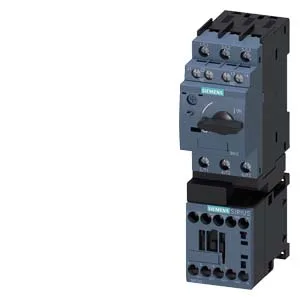
SIRIUS 3RA2 non-fused motor starter — size S00, direct starter
The Siemens 3RA2115-0KA15-1AP6 is a SIRIUS 3RA2 non-fused motor starter in size S00, configured as a direct starter — meaning it combines a contactor and overload relay in one unit for simple on/off motor control without a separate upstream fuse. It ships with a 3RT2015-1AP61 contactor, a 3RA1921-1DA00 link module, and a 3RV2011-0KA15 circuit-breaker — the breaker handles the short-circuit protection, so no additional fusing is needed in the feeder. Rated for AC-3 duty up to 690 V maximum, with power ratings of 370 W at 400 V, 550 W at 500 V, and 750 W at 690 V — sized for small motor loads like pumps, fans, and conveyors in industrial control panels.
Overload protection — Class 10 thermal bimetallic trip
The short-circuit trip is magnetic, meaning it reacts instantaneously on high fault currents; the supplied circuit-breaker 3RV2011-0KA15 coordinates with the contactor to clear faults without welding the main contacts. Operating temperature range is -20 to +60 °C, with storage from -50 to +80 °C — the bimetallic element compensates for ambient drift, but mounting in a ventilated enclosure keeps the thermal calibration accurate.
Mounting and panel fit — 45 mm width, DIN rail or screw
Width is 45 mm, depth 97.1 mm, height 167.2 mm — the S00 footprint fits standard 45 mm-wide DIN-rail slots; snap-mounts onto the rail or screws down with an additional push-in lug for vibration-prone installations. Mounting position is vertical; clearance requirements are 20 mm upward, 10 mm downward, 9 mm at the sides, and zero forward/backward — tight enough for dense panel layouts but leave the side gap for heat dissipation from the bimetallic element. Degree of pollution 3 means it's rated for conductive pollution environments typical in industrial enclosures — no conformal coating needed for normal panel conditions.
The supplied contactor (3RT2015-1AP61) and circuit-breaker (3RV2011-0KA15) are also current-production parts, so replacement spares and the complete starter share the same supply chain.