1.25 A AC-3 at 400 V — the motor-switching rating that governs fit
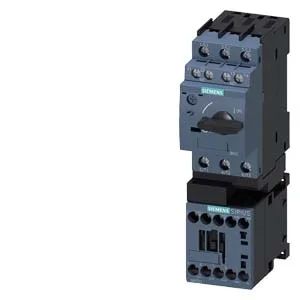
The 3RA2115-0KA16-2BB4-ZX95: That 1.25 A figure is the current the starter's contactor and overload block are designed to switch and protect continuously in a motor circuit, not a resistive-heater rating. The 24 V DC coil is the control voltage the starter expects from the PLC or relay output — confirm your control transformer or power supply delivers clean 24 V DC at the coil inrush before wiring.
Class 10 thermal overload — what it means for motor protection
The overload release is thermal bimetallic, trip class 10. For motors with longer acceleration times (high-inertia loads like centrifuges or crushers), a Class 20 or 30 relay would be needed; this starter is sized for general-purpose drives. The supplied contactor is a 3RT2016-1BB42, and the link module is 3RA1921-1DA00 — the assembly ships as a coordinated pair, so the thermal and magnetic curves are matched from the factory. No separate sizing exercise between contactor and overload.
DIN rail mounting and panel clearances
The 45 mm width is a single 9 mm module equivalent — on a standard DIN rail, 10 starters fit per 450 mm section. Depth is 97 mm, height 167 mm. Clearance requirements: 50 mm above, 20 mm forward, 10 mm below, 20 mm at the sides, and zero clearance behind. The 50 mm upward gap is the critical one — it allows hot air from the bimetallic overload to rise without recirculating into adjacent units. Crowding that clearance raises the effective ambient temperature and derates the trip curve.