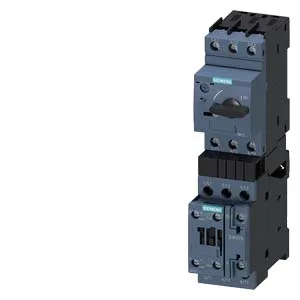
What this SIRIUS starter delivers
The 3RA2120-1KA24-0AP6: It's a direct starter design, meaning it applies full line voltage to the motor terminals on start — no reduced-voltage ramp. The overload release is thermal bimetallic, so it tracks the motor's heating curve by sensing current through a bimetal strip that bends to trip the contactor on sustained overcurrent.
CLASS 10 trip — why it matters for your motor
That's the standard for standard-duty induction motors — pumps, fans, compressors — where the starting current decays within a few seconds. If you're protecting a high-inertia load like a centrifuge or a large flywheel that takes longer to accelerate, you'd want a CLASS 20 or CLASS 30 trip curve instead; this starter won't hold through that extended start. The thermal bimetallic design is ambient-compensated across the -20 to +60 °C operating range, so the trip point stays consistent whether the panel sits in a conditioned room or a hot factory floor.
Panel fit: dimensions and mounting
The starter measures 45 mm wide by 193.1 mm tall by 97.1 mm deep — that's a single 45 mm module width on a DIN rail, so it occupies one position in a standard 19-inch subrack. Snap it onto the DIN rail or screw-mount it with the additional push-in lug; the mounting position must be vertical. Clearance requirements: allow 30 mm above, 10 mm below, 10 mm forward, 9 mm to the side, and 0 mm backward. The zero backward clearance means it can sit flush against a back panel or a busbar — useful when packing multiple starters into a tight enclosure.
Sourcing and lifecycle — current production
The starter ships as a factory-assembled unit containing the 3RT2024-1AP60 contactor and the 3RA2921-1AA00 link module. The circuit-breaker size is S00, which is one frame size smaller than the S0 feeder — that's the standard SIRIUS pairing for this rating.