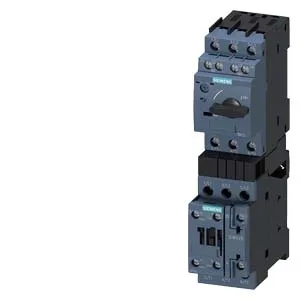
SIRIUS 3RA2 — direct starter, size S0, Class 10
The Siemens 3RA2125-4EA27-0BB4 is a non-fused motor starter from the SIRIUS 3RA2 family, configured as a direct starter in size S0. It ships with a 3RT2027-1BB40 contactor and a 3RA2921-1BA00 link module, so the assembly is matched from the factory — no separate sizing of contactor and overload relay. This is the standard for general-purpose motor starting — compressors, pumps, conveyors — where the start-up transient is brief and a faster trip protects the winding from sustained overload.
Rated power and current — what the numbers mean for the BOM
At 400 V AC-3, the starter is rated 15,000 W (15 kW). At 480 V it delivers 27 A continuous, and at 600 V also 27 A — the current ceiling is the same, but the horsepower equivalent climbs to 25 hp at 575/600 V. The maximum operating voltage is 690 V AC-3, and the unit runs on 50/60 Hz line frequency. The 24 V control coil (rated value) means this starter integrates into a standard 24 VDC control circuit — common in PLC-driven panels where the I/O and safety relays share the same low-voltage bus. No separate 110 V or 230 V control transformer needed for the starter coil.
Mounting and panel fit — DIN rail or screw-mount
The mounting position is vertical. Dimensions: 45 mm wide, 193.1 mm high, 107 mm deep — the S0 footprint is compact enough for a 600 mm wide enclosure with multiple feeders side-by-side. Clearance spaces: 30 mm upwards, 10 mm forwards, 10 mm downwards, 9 mm at the side, 0 mm backwards. The zero-backwards clearance means the starter can be mounted flush against the back panel or a busbar support without additional spacing.
Wiring and conductor sizing
Main contact terminals accept stranded wire from 1 to 10 mm², or two conductors of 2.5 to 6 mm² each. For AWG, that is 2x (16–12) or 2x (14–8). The dual-conductor capability is useful when paralleling a feed-through to a downstream device without a separate terminal block.
Environmental limits and pollution degree
Pollution degree 3 means the starter is rated for industrial environments where conductive dust or occasional condensation may occur — no need for a sealed enclosure in a typical panel.