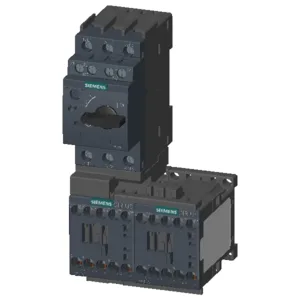
Reversing starter identity and load ratings
The Siemens 3RA2215-1KD17-2AP6 is a SIRIUS non-fused reversing motor starter in Size S00, meaning it combines a contactor pair and a thermal bimetallic overload relay in one unit to reverse a three-phase motor without external wiring between the contactors. At 400 V AC-3 duty it delivers 5.5 kW; at 480 V it is rated 11 A, and at 600 V also 11 A. Horsepower equivalents span 0.5 hp at 110/120 V up to 10 hp at 575/600 V. The maximum rated operational voltage is 690 V AC-3, so this starter handles 400 V and 480 V systems comfortably with headroom for 690 V applications where the motor full-load current stays within the Size S00 envelope.
Overload protection and trip class
The overload release is thermal bimetallic, so it tracks the motor's I²t heating curve naturally; ambient temperature compensation is built into the SIRIUS design, but the operating range is -20 to +60 °C. Type of Assignment 1 means the starter coordinates with the upstream short-circuit protective device per IEC 60947-4-1 without additional let-through testing — the S00 circuit-breaker size is matched to this feeder.
Mounting and panel integration
Fastening method is snap-on for 60 mm busbar systems — no DIN rail adapter needed; the unit clips directly onto the busbar and the vertical mounting position is mandatory for proper thermal convection through the bimetallic element. Dimensions are 200 mm height, 90 mm width, 155.1 mm depth. Clearance requirements: 20 mm upwards, 10 mm downwards, 9 mm at the side, and zero forwards or backwards — this is a tight-panel-friendly footprint for Size S00.
Supplied components and compliance
The unit ships with a 3RT2017-1AP62 contactor and a 3RA1921-1DA00 link module pre-assembled — the contactor and overload are factory-matched for coordination, so no separate selection of thermal setting or contactor rating is needed at the panel build stage. Degree of Pollution 3 per IEC 60947-1 means the starter is rated for industrial environments with conductive pollution or dry non-conductive pollution that becomes conductive due to condensation — typical for unheated enclosures in factory settings.