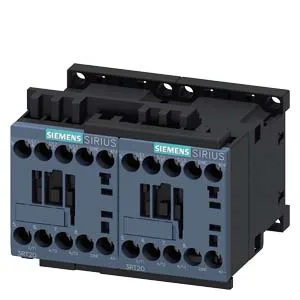
What you get in the box — two contactors, one assembly
The 3RA2316-8XB30-1FB4: This is a Siemens SIRIUS reversing contactor assembly, size S00, that ships with two 3RT2016-1FB42 contactors already supplied and wired for reversing duty. That means you don't need to source and interlock two separate contactors — it comes as a single order code with the mechanical interlock built in. That gives you options when fitting into a crowded panel. Dimensions are 90 mm wide, 68 mm high, 73 mm deep. The size S00 frame keeps it compact — it fits where full-size reversing starters won't.
Motor ratings that decide the fit
Rated for AC-3 duty up to 690 V maximum. At 400 V it handles 4 kW; at 500 V also 4 kW; at 690 V it goes to 5.5 kW. The AC-3 maximum switching rate is 750 operations per hour. If your application cycles faster than that — say a rapid-reversing conveyor — you'll need to step up to a larger frame or a dedicated reversing contactor with higher duty class. Coil voltage is 24 V DC. The magnet coil uses screw-type terminals, same as the main circuit. Keep the control wiring consistent — 24 V DC is common in modern PLC-driven panels, but verify your control transformer or power supply can deliver the inrush without dipping below the dropout threshold.
Wiring and terminal capacity
That covers most motor feeder sizes up to 4 mm² — enough for the 4 kW motor at 400 V. The solid/stranded spec applies to both the main circuit and the coil terminals. Screw-type terminals throughout — no push-in or spring-cage on this assembly, so budget for a screwdriver and the torque spec from the installation instructions.
Environmental limits and vibration resistance
That covers most indoor panel environments, but if the panel sits in an unconditioned shed in a northern winter, the -25 °C floor is fine — the -55 °C storage means it can sit on a cold truck overnight. Vibration tested at 10.5 g for 5 ms and 6.6 g for 10 ms, both AC and DC. That's a solid spec for machinery-mounted panels — it won't drop out on a press or a conveyor drive. Clearance around the assembly: 6 mm upwards, forwards, downwards, and to the side; 0 mm backwards. The zero backward clearance means it can sit flush against the back panel or a busbar — useful in tight enclosures.
Sourced through independent distribution channels. No stock-holding claim on this listing; submit an RFQ for your volume.