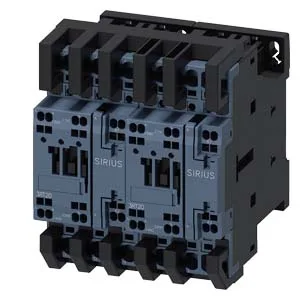
Motor power across the voltage range
The 3RA2327-8XB30-2AG2: At 480 V it carries 27 A, matching the same current rating at 600 V — the thermal limit holds across the 480–600 V band, so the motor power ceiling rises with voltage.
Termination and wiring constraints
The dual-wire entry per pole simplifies daisy-chaining in a reversing scheme where the forward and reverse contactors share a common line feed.
Mounting and panel clearances
Clearance for ventilation: 6 mm upwards, forwards, downwards, and to the side; 0 mm backwards (the DIN rail surface). This is tight enough that adjacent devices should not be butted directly against the sides if the ambient is near the 60 °C operating ceiling.
Switching duty and mechanical endurance
Maximum switching rate in AC-3 and AC-3e duty is 750 operations per hour — this governs jogging or inching applications where the reversing contactor cycles frequently. The mechanical life of the supplied contactor (3RT2027-2AG20) is rated 10 million operations typical, so the limiting factor in a high-cycle reversing station is the electrical wear on the main contacts, not the mechanism. Each direction of rotation uses one contactor, with one supplied as part of the assembly. The auxiliary contact block provides 2 instantaneous contacts — enough for a basic interlock and status feedback to the PLC without adding an auxiliary block.
Environmental tolerance
Vibration resistance is specified at 13.5 g / 5 ms and 8.3 g / 10 ms on AC, with slightly higher DC ratings at 15 g / 5 ms and 10 g / 10 ms — relevant if the panel is mounted on a machine frame or in a mobile application.