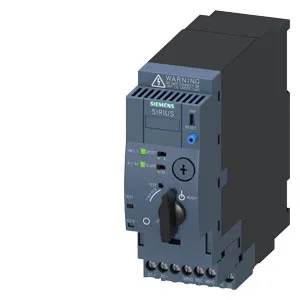
Short-circuit rating that sets the panel coordination
The 3RA6120-1AB33: This SCCR headroom means the starter can be applied downstream of a high-capacity feeder without requiring a current-limiting upstream device for most industrial distribution systems — the coordination study stays simpler. The adjustable trip class (CLASS 10 and 20) lets the overload relay match the motor start profile: CLASS 10 for high-inertia loads like crushers or conveyors that need a fast trip on stall, CLASS 20 for pumps or fans with longer acceleration times.
Mounting and wiring for panel density
Mounts on standard DIN rail, vertical or horizontal orientation, with screw and snap-on fastening. The 45 mm width and 170 mm height fit a compact footprint — three units side-by-side occupy 135 mm of rail, leaving room for a terminal block row above or below. This covers standard motor feeder cables up to 4 mm² (approx 12 AWG) without needing a ferrule or bootlace — direct screw-clamp termination.
Environmental tolerance for industrial floors
Rated for continuous operation per IEC 60947-6-2, with an operating temperature range of -20 to +60 °C and storage/transport range of -55 to +80 °C. The shock resistance of 60 m/s² (6g) and vibration profile (4–5.8 Hz at 15 mm, 5.8–500 Hz at 20 m/s²) mean it holds up on a machine frame or conveyor line without nuisance trips. Power dissipation is 2.8 W at AC maximum and 2.9 W at DC maximum — low enough that thermal buildup in a sealed enclosure is manageable; no forced cooling required for a single unit, but group derating applies in a multi-starter panel.
Coil voltage and control compatibility
The control coil accepts 24 V AC/DC — a single part number covers both AC and DC control supplies, simplifying BOM management. The 24 V level is standard across most PLC output cards and safety relays, so no interface relay is needed for the control signal.