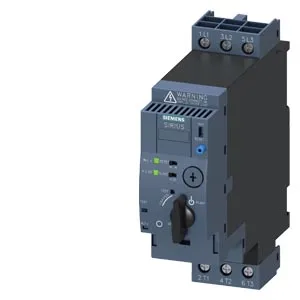
53 kA at 400 V — what it means for your panel
The 3RA6120-1BB34 carries a short-circuit breaking capacity of 53 kA at 400 V AC. The trip class is adjustable between CLASS 10 and CLASS 20. CLASS 20 gives more ride-through for high-inertia loads like fans or centrifuges. The adjustment is on the overload relay itself; no separate module needed.
Control voltage and wiring — 24 V AC/DC, universal
The control coil accepts 24 V AC at 50 Hz, 24 V at 60 Hz, and 24 V DC — the type of voltage is AC/DC, so a single part covers both a 24 VDC PLC output and a 24 VAC control transformer. No need to stock separate AC and DC coil variants. Power dissipation is 2.8 W at AC maximum and 2.9 W at DC maximum. In a densely packed panel with multiple starters running continuously, that heat adds up — budget the thermal load into the enclosure's ventilation or forced-air cooling. The dual-conductor rating is useful for daisy-chaining the supply through the starter without a separate terminal block.
Mechanical fit — DIN rail, 45 mm wide, any orientation
The starter is 45 mm wide, 170 mm tall, and 165 mm deep — a standard 45 mm module width that fits on a DIN rail with snap-on mounting. The depth of 165 mm means it will clear most 200 mm deep enclosures, but check the gland plate clearance if the panel is shallow. Mounting position is any, though the recommended orientation is vertical on a horizontal standard mounting rail. The vibration resistance is tested to 4–5.8 Hz at 15 mm displacement and 5.8–500 Hz at 20 m/s², and shock resistance is 60 m/s² (6g) for 10 ms — suitable for machine-mounted applications with moderate vibration.
Environmental and compliance — pollution degree 3, wide temperature range
The degree of pollution is 3, meaning the starter is rated for conductive pollution or dry non-conductive pollution that becomes conductive due to condensation — typical for industrial control panels not in a clean-room environment. Operating temperature range is -20 to +60 °C, storage and transport range is -55 to +80 °C. Two LED indicators are present for status — typically power on and trip/fault indication. No IO-Link or AS-Interface protocol support; this is a conventional hardwired starter.