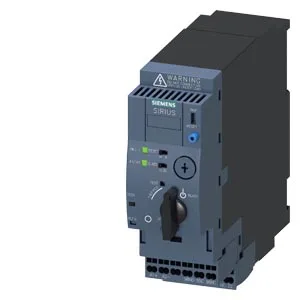
53 kA interrupting capacity — what it means for panel coordination
The 3RA6120-2DB33 is rated 53 kA at 400 V — this is the prospective short-circuit current it can safely interrupt at the main distribution level without upstream fuses or breakers needing to clear first.
Trip Class 10 and 20 adjustable — setting the overload curve
The overload relay is adjustable between Trip Class 10 and 20, letting you match the thermal memory to the motor start profile — Class 10 for fast-starting loads like pumps and fans, Class 20 for high-inertia loads like conveyors or crushers that need a longer acceleration ramp. This is a direct starter design rated for continuous operation per IEC 60947-6-2, so it is intended for across-the-line starting without a soft-start or VFD — the trip class setting is the only thermal tuning available.
24 V DC/AC coil — universal control voltage for global panels
Coil holding power is 2.8 W AC maximum and 2.9 W DC maximum, which keeps the thermal load on the DIN-rail cluster low — relevant when multiple starters share a small enclosure without forced ventilation.
DIN-rail footprint and mounting — 45 mm width, screw or snap-on
Width is 45 mm, height 191 mm, depth 165 mm — the 45 mm width matches the standard 45 mm module pitch, so it occupies one position on a DIN rail and leaves room for adjacent devices without crowding. The main circuit connection is plug-in without terminals — the starter plugs into a separate terminal base, so you can pre-wire the panel and snap the starter in later without disturbing the power wiring.
Environmental and mechanical endurance — shock, vibration, temperature
Shock resistance is 60 m/s² (6g) with 10 ms pulses, three shocks per axis; vibration resistance covers 4 to 5.8 Hz at 15 mm amplitude and 5.8 to 500 Hz at 20 m/s² for 10 cycles — this starter is specified for machinery with moderate vibration, not for heavy mining shakers. Operating temperature range is -20 to +60 °C; storage and transport range is -55 to +80 °C — the -20 °C lower limit means it is not rated for freezer or arctic outdoor installation without a heated enclosure. Pollution degree 3 means it is suitable for industrial environments with conductive pollution or dry non-conductive pollution that becomes conductive due to condensation — typical for unsealed control panels in factory floors.