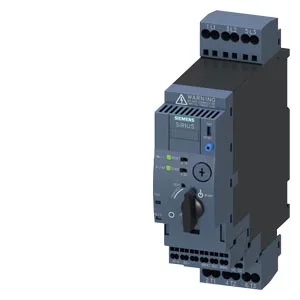
The Siemens 3RA6120-2EB32 is a SIRIUS compact starter — a direct starter design that combines a contactor and overload relay in a single 45 mm wide housing. It's built for continuous operation per IEC 60947-6-2, meaning it handles motor starting and running protection without needing separate components on the DIN rail. Control voltage is 24 V AC/DC, so it works on either supply without rewiring. The coil draws 3.5 W AC maximum or 3.1 W DC maximum, which keeps the control transformer small in a crowded panel. For motor protection, the trip class is adjustable between CLASS 10 and CLASS 20. That means you set it for faster tripping on normal-start loads (CLASS 10) or allow longer inrush on high-inertia loads like fans or conveyors (CLASS 20). Rated at 32 A at 480 V, it covers a 15 kW motor at 400 V and a 7.5 hp motor at 200/208 V.
Mounts vertically on a standard DIN rail using the screw and snap-on method. The 45 mm width fits a standard 4-module slot in a distribution board. Mounting position is any orientation, but Siemens recommends vertical for optimal heat dissipation. Spring-loaded terminals on the main circuit accept solid or stranded wire from 0.25 to 1.5 mm² (2x conductors). No screwdriver needed for termination — strip, push, and the cage clamps. That speeds up panel wiring and eliminates screw torque issues. Two LEDs on the front give status indication: one for power, one for trip or fault. No IO-Link or AS-Interface protocol onboard — this is a standalone starter, not a networked device.
Environmental and mechanical specs
Shock resistance is 60 m/s² (6g) for 10 ms across all three axes. Vibration resistance covers 4 to 5.8 Hz at 15 mm amplitude and 5.8 to 500 Hz at 20 m/s² for 10 cycles. That's enough for most machine-mounted applications, but not for extreme off-road or marine engine mounts without additional isolation. Dimensions are 191 mm high, 45 mm wide, 165 mm deep. The depth includes the terminal overhang — plan for at least 180 mm clearance in front of the DIN rail for wiring access.
No adapter plates or wiring changes needed if replacing a failed unit. The spring terminals match the same wire range as the screw-terminal variants, so re-termination is straightforward.