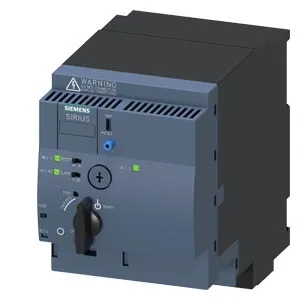
Breaking capacity and trip class — what they mean for the line
The 3RA6250-0CB30: Rated 53 kA at 400 V — this is the short-circuit breaking capacity the starter can safely interrupt without upstream fuses or a larger MCCB taking the fault. It meets the SCCR requirement for most industrial distribution panels up to that fault level. Trip class is adjustable between CLASS 10 and CLASS 20 (per IEC 60947-6-2). CLASS 10 trips faster on overload — better for protecting motors with short thermal time constants (e.g., pumps, fans). CLASS 20 allows longer starting current duration, useful for high-inertia loads like conveyors or crushers. The adjustment is a simple selector on the unit, no separate heater element needed.
Panel fit and mounting — DIN rail, screw, or snap-on
Footprint is 165 mm deep, 90 mm wide, 170 mm high — fits a standard DIN-rail enclosure bay. Mounting is screw and snap-on onto horizontal standard DIN rail; the reversing starter can be oriented vertically or in any position, giving layout flexibility in tight cabinets. The main current circuit uses a plug-in connection without terminals — the power wiring is through a separate base or adapter, not directly onto the device. This speeds replacement: swap the starter without disturbing the line-side wiring.
Environmental ruggedness — shock, vibration, temperature range
Rated for continuous operation per IEC 60947-6-2, with an operating temperature range of -20 to +60 °C and storage/transport from -55 to +80 °C. Shock resistance is 60 m/s² (6 g) for 10 ms, three shocks per axis. Vibration resistance covers 4–5.8 Hz at 15 mm amplitude, and 5.8–500 Hz at 20 m/s², 10 cycles — suitable for machine-mounted applications near rotating or reciprocating equipment. Degree of pollution 3 — the unit tolerates conductive dust and occasional condensation, typical for industrial control panels not in sealed cleanrooms.