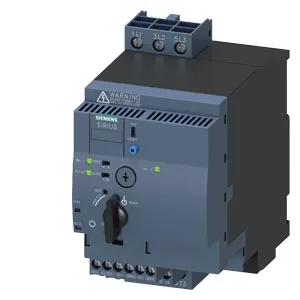
The Siemens SIRIUS 3RA6250-1BP32 is a compact reversing starter — a single device that handles forward/reverse motor control in one package, saving panel space over two separate contactors with mechanical interlocking. It's rated for continuous operation per IEC 60947-6-2, so it's built for sustained duty on conveyors, pumps, or any reversing load that runs for hours. It means this starter can sit downstream of a transformer or a high-capacity bus without needing a separate current-limiting fuse or breaker upstream, as long as the SCCR of the whole assembly is coordinated. Trip class is adjustable between Class 10 and Class 20. Class 10 gives faster overload protection for pumps and compressors that shouldn't coast long under fault; Class 20 allows a longer start for high-inertia loads like fans or centrifuges. You set it on the device, not by swapping heaters.
Mounting and wiring — what fits in the panel
The screw terminals accept solid wire from 0.5 mm² up to 4 mm², or two conductors of 0.5 to 2.5 mm² in the same clamp — useful for daisy-chaining control power or paralleling a sense wire without a separate terminal block. Dimensions are 170 mm high by 90 mm wide by 165 mm deep. That depth is the critical one for shallow enclosures — check your gland plate clearance if the panel is less than 180 mm deep. Mounting position is any orientation, but the recommended installation is vertical on a horizontal DIN rail for natural convection cooling. Three LEDs on the front give local status indication — helps a field tech see at a glance whether the starter is powered, tripped, or in a fault state without breaking out a meter.
Environment and lifecycle
Vibration resistance is tested to 20 m/s² at 5.8 to 500 Hz, and shock to 60 m/s² (6 g) — it'll hold up on a machine base or a conveyor frame, not just a climate-controlled control room.
Power and control voltage
Control supply is AC/DC, 110 to 240 V at 50 or 60 Hz. That covers the common control voltages in most industrial plants — 120 V AC and 240 V AC single-phase, plus 110 V DC and 220 V DC. Power consumption is low: 6 W AC maximum, 5.1 W DC maximum, so it won't heat up a crowded panel. Motor power rating at 400 V is 370 W (0.5 hp). At 460/480 V it's also 0.5 hp, with a full-load current of 1.25 A. That's a small motor — think agitators, small conveyors, valve actuators, not a 10 hp pump.