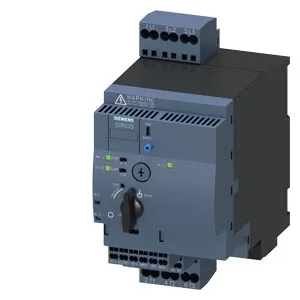
The 3RA6250-2BB32: The reversing function is built into a single 90 mm wide housing, so a forward-reverse motor pair fits in one DIN-rail footprint rather than two separate contactors with a mechanical interlock. The unit is rated for continuous operation per IEC 60947-6-2, meaning it handles sustained motor loads without derating.
Adjustable overload protection and spring-clamp wiring
Trip class is field-selectable between CLASS 10 and CLASS 20 via a dial on the front. CLASS 10 protects motors with short acceleration times (pumps, fans), while CLASS 20 allows longer start-up for high-inertia loads like conveyors or crushers — both settings are in one device, no module swap needed. Spring-clamp termination eliminates the need for torque-checking screw terminals and resists loosening under vibration — relevant for the shock resistance rating of 60 m/s² (6g) over 10 ms per axis. Control voltage is 24 V AC/DC, with a maximum power draw of 2.8 W at AC and 2.9 W at DC. The 24 V coil is common across modern PLC-based panels, and the low power consumption keeps the control transformer sizing tight.
DIN-rail envelope and environmental limits
Dimensions are 191 mm high, 90 mm wide, 165 mm deep — a standard SIRIUS form factor that fits alongside other SIRIUS devices on a horizontal standard DIN rail. Mounting position is any orientation, with screw and snap-on fastening for the rail. Operating temperature range is -20 to +60 °C, storage and transport range -55 to +80 °C. Pollution degree 3 means it tolerates conductive dust and humidity typical of industrial enclosures without conformal coating. Vibration resistance is specified at 4 to 5.8 Hz with 15 mm amplitude and 5.8 to 500 Hz at 20 m/s² for 10 cycles — this covers most rotating machinery environments up to medium-impact applications.
No official successor or cross-reference has been published by Siemens for this order code. The SIRIUS series is mature and widely stocked, but each variant's control voltage and trip class are specific — confirm the BOM line before committing.