Active production — what that means for your BOM line
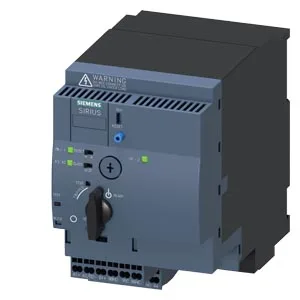
The 3RA6250-2BB33: This is a SIRIUS compact reversing starter — a single device that combines a contactor, overload relay, and reversing interlock in one 90 mm wide housing. Rated 370 W at 400 V, it handles small reversing motor loads — conveyors, gate drives, valve actuators — where panel space is tight and the reversing function is built in, not wired externally.
53 kA SCCR at 400 V — the so-what for panel coordination
The 53 kA rated short-circuit current at 400 V means this starter can be installed on a supply with up to 53 kA prospective fault current without needing a current-limiting upstream breaker to protect it. For a panel builder, that simplifies the selectivity study — the starter is self-protecting at that fault level, so the upstream MCCB or fuse only needs to coordinate for discrimination, not for the starter's survival. The adjustable trip class (CLASS 10 and 20,) lets you match the thermal memory to the motor's acceleration profile. CLASS 10 for fast-starting loads (pumps, small fans), CLASS 20 for high-inertia loads (centrifuges, flywheels) that need a longer start duration without nuisance tripping. This is set via a dial on the overload block — no module swap required.
The 90 mm width and 191 mm height mean it occupies roughly the footprint of two standard contactors side by side — but with the reversing interlock integrated, you save the wiring and the interlock hardware. Depth is 165 mm, which fits standard 200 mm deep enclosures with room for the outgoing cable bend radius. For the main power circuit, the plug-in terminal system means the power block is pre-wired to the panel and the control module snaps on separately, reducing wiring errors on repeat builds.
Environmental and mechanical endurance
That covers most indoor industrial environments without derating — the limiting factor is the ambient heat inside the enclosure, not the starter itself. Shock resistance is 60 m/s² (6g) for 10 ms per 3 shocks in all axes, and vibration resistance follows a 4–5.8 Hz / 15 mm displacement and 5.8–500 Hz / 20 m/s² profile for 10 cycles. This is sufficient for machine-mounted applications on presses, conveyors, and packaging equipment — not just panel-mounted in a fixed electrical room.