Panel fit and mounting constraints
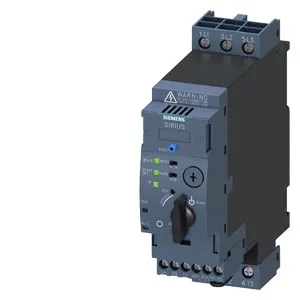
The 3RA6400-1BB42 measures 45 mm wide by 170 mm tall by 165 mm deep — a 45 mm footprint on the DIN rail, so it occupies one standard 45 mm slot in a panel layout. Mounting is screw-and-snap-on to a standard DIN rail; orientation is vertical on a horizontal rail per the recommended method, though any mounting position is allowed. That covers most control-circuit and small motor feeds up to 370 W at 400 V.
IO-Link and adjustable trip class
This is a SIRIUS compact direct starter with IO-Link protocol at COM2 (38.4 kBaud). The three onboard LEDs give local status indication for the IO-Link communication and device state — useful during commissioning without a handheld tool. Trip class is adjustable between CLASS 10 and CLASS 20. CLASS 10 clears faster for motors with short acceleration times; CLASS 20 allows longer inrush during heavy starts. Set it to match the motor's acceleration profile — a pump start might stay CLASS 10, a high-inertia fan may need CLASS 20.
Breaking capacity and coordination
Rated short-circuit breaking capacity is 53 kA at 400 V — that's the fault current the starter can safely interrupt without upstream devices needing to clear. For a 370 W motor at 400 V drawing 1.25 A, the 53 kA rating gives ample headroom for high-fault-capacity installations like industrial substations or data-center power distribution. The starter is rated for continuous operation per IEC 60947-6-2, with a pollution degree of 3 (conductive pollution or dry non-conductive pollution that becomes conductive due to condensation). That means it's suited for industrial environments where the enclosure isn't climate-controlled.
Environmental and mechanical endurance
Operating temperature range is -20 to +60 °C; storage and transport range is -55 to +80 °C. Shock resistance is 60 m/s² (6 g) with 10 ms pulses, three shocks per axis. Vibration resistance follows a stepped profile: 4 to 5.8 Hz at 15 mm amplitude, then 5.8 to 500 Hz at 20 m/s², 10 cycles — this covers most rotating machinery vibration spectra. Mechanical endurance for the main contacts is 10 million operations typical; no-load switching frequency is 3,600 cycles per hour. That's a fast-moving part for applications with frequent start/stop cycles — conveyor segments, packaging lines, or indexing tables.