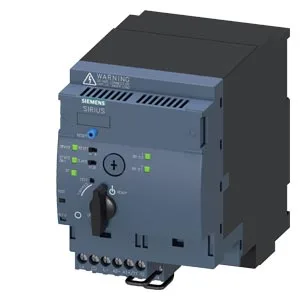
Rated for continuous operation per IEC 60947-6-2, it handles motor starts and stops in both forward and reverse without external interlocking. The adjustable trip Class 10 and 20 lets you match the thermal overload curve to the motor's starting profile — Class 10 for shorter start times like fans or pumps, Class 20 for higher-inertia loads like conveyors or crushers.
IO-Link and control integration
IO-Link protocol is built in at COM2 (38.4 kBaud), giving the PLC direct access to the starter's diagnostic data — trip status, current draw, thermal capacity utilization — over a standard M12 cable, no analog or discrete I/O card needed. The 5 on-board LEDs provide local status indication for power, communication, and fault conditions, useful during commissioning and troubleshooting. Control voltage is 24 V DC, which is standard for modern PLC cabinets; the coil dissipation is 2.9 W at rated voltage, so thermal rise in a dense panel is manageable.
Width is 90 mm, height 170 mm, depth 165 mm — fits a standard 90 mm-wide DIN-rail slot; stacking multiple units side-by-side is straightforward. Shock-rated at 60 m/s² (6 g) for 10 ms, three shocks per axis, and vibration-rated per the listed profile — suitable for installation on machinery or conveyors with moderate mechanical stress.
Main circuit connections are plug-in without terminals — the mating plug accepts solid conductors from 0.5 to 4 mm², or two conductors from 0.5 to 2.5 mm² each, which covers standard motor wiring up to the 4 A rating.