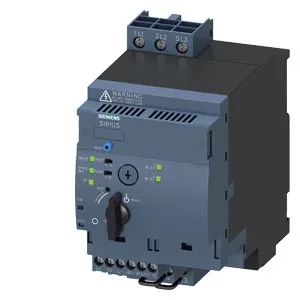
The AC-3 rating of 15 kW at 400 V tells you this starter is sized for standard three-phase squirrel-cage motors in that power band — conveyors, pumps, fans where reversing is needed. The adjustable trip class (CLASS 10 and 20) lets you match the overload curve to the motor start profile: Class 10 for faster starts like compressors, Class 20 for high-inertia loads like centrifuges. Set it before you button up the panel. Dimensions of 170 mm high, 90 mm wide, and 165 mm deep fit a standard DIN-rail footprint — screw and snap-on mounting means it clips onto the rail and can be screwed for vibration resistance. The shock rating of 60 m/s² (6g) and vibration resistance up to 20 m/s² at 5.8–500 Hz mean it holds up on mobile equipment or near heavy machinery.
This is a reversing starter — so it integrates a forward contactor, a reverse contactor, and an overload relay in one housing. On a DIN rail, it replaces the separate three-device stack, freeing up about 45 mm of width. The IO-Link interface (COM2, 38.4 kBaud) means the PLC can read the overload status, trip class setting, and motor current directly — no separate digital inputs needed for feedback. Five LEDs on the front give you local status at a glance without opening the panel door. Wire the main circuit with 0.5 to 4 mm² solid or stranded into the screw terminals — the terminals accept two conductors per clamp (2x 0.5 to 2.5 mm²) for daisy-chaining. The 24 V DC coil terminals are clearly marked; polarity matters on the electronics side, so check the wiring diagram before applying power.