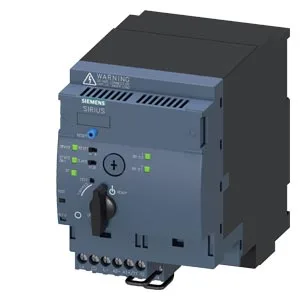
What the 15 kW AC-3 rating means for motor control
The 3RA6500-1EB43: The 15 kW at 400 V AC-3 rating tells you this reversing starter handles full-load motor switching for pumps, conveyors, and fans up to that power — the AC-3 duty cycle covers starting and plugging, not just steady-state running. Trip class is adjustable between Class 10 and Class 20, so you can match the overload curve to the motor's starting profile — Class 10 for high-inertia loads that accelerate quickly, Class 20 for longer start times on fans or crushers.
IO-Link integration and control voltage
This is a compact reversing starter with IO-Link — the 24 V DC control voltage powers both the coil and the IO-Link interface, so you get parameterization, diagnostics, and status feedback over a single M12 connection. The IO-Link transfer rate is COM2 at 38.4 kBaud, which is the standard speed for most PLC masters. Five onboard LEDs give local status for power, communication, and fault conditions — useful for a tech walking the panel without needing a handheld tool. No AS-Interface protocol — this is strictly IO-Link, so don't plan to drop it onto an AS-i network without a gateway.
Mounting, wiring, and environmental fit
Dimensions are 170 mm high, 90 mm wide, 165 mm deep — fits a standard 200 mm deep enclosure. The main circuit uses a plug-in connection without terminals, so the power block mates directly to a pre-wired base. Operating temperature is -20 to +60 °C, storage and transport -55 to +80 °C. Pollution degree 3 means it's rated for conductive pollution environments — typical for industrial control panels without climate control.
Mechanical endurance and vibration resistance
Main contacts rated for 10,000,000 mechanical operations, auxiliary contacts the same — this is a high-cycle device suitable for frequent reversing applications like indexing conveyors or door operators. No-load switching frequency is 3,600 operations per hour, which is one per second — fast enough for most sequencing. Vibration resistance tested to 20 m/s² at 5.8 to 500 Hz, with 15 mm displacement at lower frequencies. Shock resistance is 60 m/s² (6g) for 10 ms, three shocks per axis — meets the typical IEC 60068-2-6 and -2-27 levels for industrial machinery.