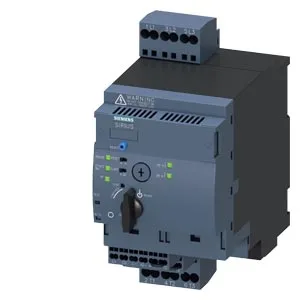
Reversing starter for motor control panels
The Siemens 3RA6500-2DB42 is a SIRIUS compact reversing starter designed for continuous motor duty per IEC 60947-6-2. It combines a contactor and overload relay in one housing, with the reversing pair built in — so you get forward/reverse control without wiring two separate contactors and an interlock. The 53 kA SCCR means it can sit downstream of a high-capacity feeder without needing a current-limiting upstream device — useful when you're coordinating a panel with multiple motor branches.
Trip class and thermal protection — adjustable for the load
The overload relay is adjustable between trip class 10 and 20. Class 10 is the standard for most general-purpose motors — it trips fast enough to protect the winding during a stall. Class 20 gives a longer thermal memory, which matters for high-inertia loads like fans or centrifuges that take several seconds to spin up. You set it with a switch on the front; no need to swap heater packs. The continuous operation rating (IEC 60947-6-2) means the starter is rated for uninterrupted motor running, not just intermittent jogging. The no-load switching frequency of 3,600 operations per hour tells you the mechanical life is generous for a reversing starter — it can handle frequent direction changes in conveyor or shuttle applications.
Wiring and mounting — spring terminals, DIN rail
The main current circuit uses spring-loaded terminals — push-in for solid or ferruled stranded wire, 2x 0.25 to 1.5 mm² per clamp. No screw torque to check, no vibration loosening. The control circuit is 24 V DC, which is the standard for modern PLC-driven panels. Mounting is screw-and-snap-on to a standard DIN rail. The footprint is 90 mm wide, 191 mm tall, 165 mm deep — about four module widths on a 35 mm rail. Mounting position is any, but the recommended orientation is vertical on a horizontal rail for best heat dissipation from the overload element.
IO-Link communication and diagnostics
This starter supports IO-Link protocol at COM2 (38.4 kBaud). That gives you access to five status LEDs plus process data — load current, trip count, thermal capacity used — over a standard M12 connection. For a commissioning engineer, this means you can verify motor current and overload status from the PLC without climbing into the panel. The 24 V DC control supply powers both the coil and the IO-Link interface. Power dissipation at DC is 2.9 W maximum — negligible for panel thermal budgeting, but worth noting if you're running a dozen of these in a sealed enclosure.
Environmental endurance — shock, vibration, temperature
Rated for shock resistance of 60 m/s² (6g) with 10 ms pulses, three shocks per axis. Vibration resistance is 15 mm displacement at 4–5.8 Hz, then 20 m/s² acceleration at 5.8–500 Hz, 10 cycles. That puts it in the range for machine-mounted applications — conveyors, pumps, compressors — where the starter sees the machine's vibration, not just the panel floor. Operating temperature range is -20 to +60 °C; storage and transport range is -55 to +80 °C. Pollution degree 3 means it's rated for conductive pollution in industrial environments — no special coating needed for most factory floors.