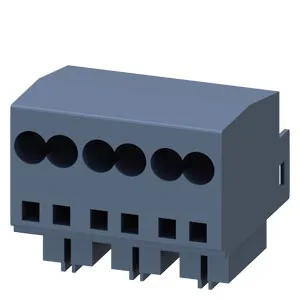
Panel fit — the dimensions that decide the row
The 3RA6920-2A: At 45 mm wide, 32 mm tall, and only 30 mm deep, this terminal block tucks into the tightest DIN-rail rows — the shallow depth leaves room behind for wiring ducts or a second rail layer. The spring-loaded main circuit terminals accept solid or finely stranded copper: up to 12 A you can land two conductors per clamp (1.5–6 mm² each), and up to 32 A still allows two conductors (2.5–6 mm² each). That dual-conductor entry lets you daisy-chain motor feeds without an extra junction block. Stripped length is a uniform 10 mm — set your wire stripper once and work through the whole panel.
What the spring-clamp terminals mean for the wireman
Spring-loaded (cage-clamp) terminals on both the main circuit and the auxiliary/control circuit — no screw torque to verify, no vibration loosening over time. The clamp holds the full conductor cross-section without cold flow. AWG equivalents are listed alongside metric: up to 12 A you can land 2x (16–14 AWG), 2x (14–10 AWG), or a single 8 AWG; up to 32 A accepts 2x (14–10 AWG) or a single 8 AWG. Finger-safe IP20 front protection per IEC 60529 means an operator brushing against the terminal strip during troubleshooting won't contact live metal — a real help when the panel is powered for diagnostics.
Environmental envelope — where it lives in the cabinet
Rated for -20 to +60°C during operation, with storage and transport tolerance from -55 to +80°C. That covers unheated warehouses in winter and sun-loaded enclosures in summer without derating. Relative humidity during operation is 10–90% — no special coating needed for most indoor industrial environments, but if your line sees condensation cycles, the IP20 front still keeps moisture off the live terminals.
Part of the SIRIUS family — the same accessory platform used across Siemens motor starters, so panel spares and expansion share a common terminal system.