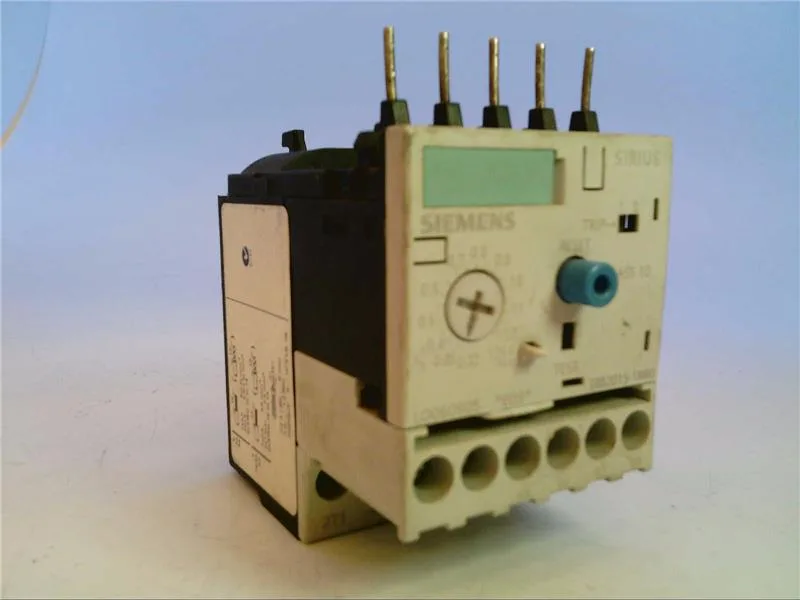
The Siemens 3RB2015-2RB0 is a SIRIUS solid-state overload relay — it protects motors by monitoring current and tripping on overload, but does it without the moving bimetal strip of a traditional thermal relay. It mounts directly onto a contactor (contactor mounting), saving DIN-rail space inside the panel. The enclosure is IP20 — finger-safe for the panel interior, but not for washdown environments. The main circuit terminals accept solid conductors from 0.5 to 4 mm² (or 2× 0.5 to 2.5 mm²), and AWG equivalents 2× 18 to 14. Screw-type terminals are used for the main current circuit.
The auxiliary contact ratings are given at several voltages: 4 A at 120 V, 3 A at 230 V, 2 A at 24 V, and 0.55 A at 60 V. These are the switching capacities for the signal contacts; the 120 V and 230 V figures are the ones you'll use for a PLC input or contactor coil feedback. Shock resistance is 15g for 11 ms — robust enough for machine-mounted applications near presses or conveyors. EMC immunity is specified: surge voltage resistance at 6 kV, and burst immunity at 2 kV on power ports and 1 kV on signal ports (severity level 3 per IEC 61000-4-4). That means it will hold its trip accuracy in electrically noisy industrial environments without nuisance tripping.
This relay is for motor protection in control panels — the SIRIUS line is Siemens' standard modular system for motor feeders. The CLASS 20E trip curve matches general-purpose induction motors driving centrifugal pumps, fans, compressors, and light conveyors. It's not for high-inertia loads that need a longer trip class (CLASS 30) or for submersible pumps that need a faster one (CLASS 10). The ATEX certification (PTB 06 ATEX 3001 Ex II (2) GD) means it can be used in the control circuit of equipment installed in Zone 2 gas or Zone 22 dust areas — the relay itself sits in the safe area but protects motors in the hazardous zone.
Because it's a current-production Siemens SIRIUS component, lead times are standard for the line — no broker or surplus channel required.
Mounts directly onto the contactor — no DIN rail needed for the relay itself, though the contactor will be DIN-rail mounted. Clearances: 0 mm upwards, forwards, and backwards; 6 mm at the side. That means it can be packed tight against other components above, below, and behind, but needs 6 mm lateral breathing room.