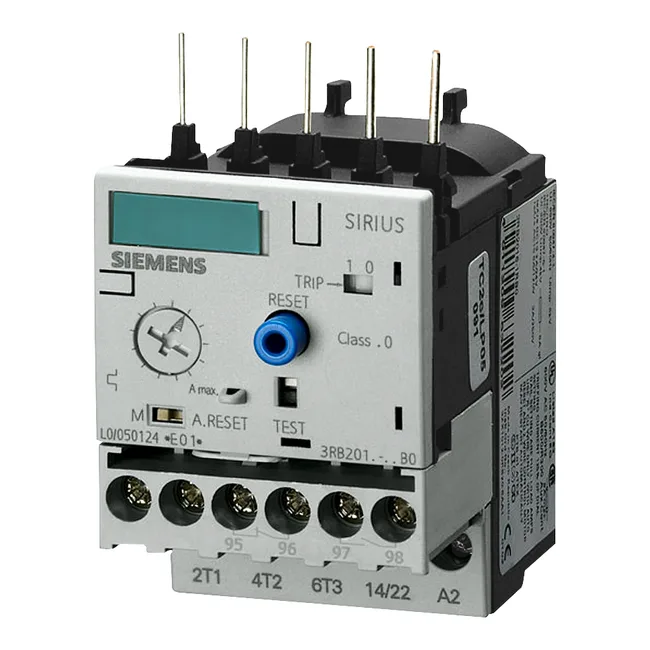
The Siemens SIRIUS 3RB2016-2ND0 is a solid-state overload relay — the electronic equivalent of a bimetal relay, protecting a three-phase motor from sustained overcurrent without the thermal drift of a mechanical heater. The CLASS 20E trip class means it allows a locked-rotor current (typically 6× FLA) to persist for roughly 10–20 seconds before tripping, which is the standard choice for standard-start induction motors driving pumps, fans, or compressors where the start is under 10 seconds. This relay mounts directly onto a contactor (contactor mounting, per the spec) rather than onto a DIN rail, saving panel width — the unit is 45 mm wide, 64 mm tall, and 73 mm deep, sized to sit flush on the matching SIRIUS contactor.
Three poles for the main current circuit, with screw-type terminals on the power side accepting 2× (0.25 … 1.5 mm²) solid or 2× (18 … 14 AWG) stranded. The auxiliary and control circuit uses spring-loaded terminals, which means no re-torquing during thermal cycling — a reliability point for panels subject to vibration or temperature swings. The auxiliary contact ratings are given per voltage: 2 A at 24 V, 4 A at 120 V, 3 A at 230 V, and 0.55 A at 60 V, 0.3 A at 110/125 V, 0.11 A at 220 V — these are the make/break capacities for the signal side, not the motor power circuit. Surge voltage resistance is rated at 6 kV, and EMC burst immunity meets 2 kV on power ports and 1 kV on signal ports (severity level 3 per IEC 61000-4-4). That means it can live in a panel with contactors and drives without false tripping from line transients.
Where it goes and what approvals it carries
This is a motor-protection device for a control panel — it sits between the contactor and the motor, monitoring phase current and tripping the contactor coil on overload. The ATEX approval (PTB 06 ATEX 3001 Ex II (2) GD) means it can be used in the control circuit of equipment installed in a potentially explosive atmosphere (gas or dust), specifically as a protective device associated with category 2 equipment. The operating temperature range is -25 … +60 °C, storage and transport -40 … +80 °C, with 100 % relative humidity allowed during operation — so it can go into a washdown-adjacent enclosure without a heater.