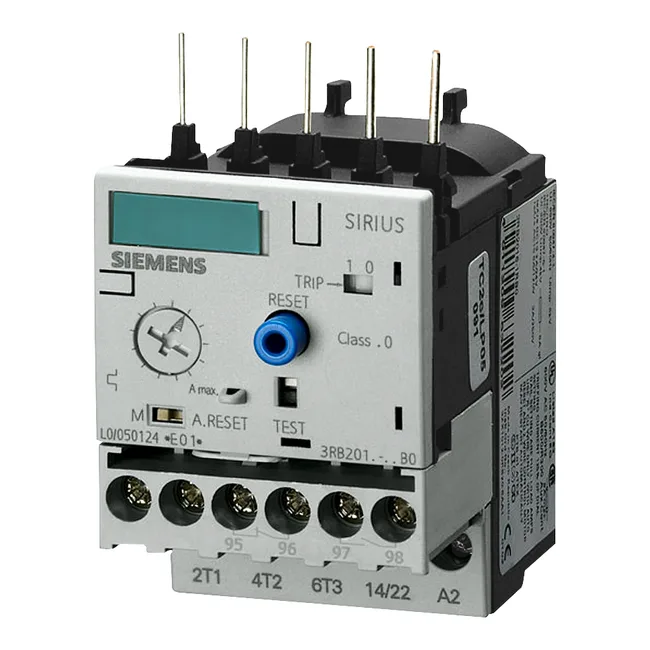
It protects motors against overload and phase failure by monitoring current and tripping within the Class 20 time band.
The auxiliary contact ratings — 2 A at 24 V, 4 A at 120 V, 3 A at 230 V — tell you the switching capacity of the internal N/O and N/C contacts used in the control circuit; these are what the PLC or safety relay sees. The 0.05 W power dissipation in hot operating state (0.02 W per pole) is low enough that no special derating is needed in a crowded enclosure, but it adds up if you stack multiple relays on the same contactor.
Mounts directly onto a contactor (contactor mounting) — no DIN rail required. That zero-clearance envelope means you can butt it against adjacent devices without worrying about heat buildup or arc flash, as long as the side gap is respected. Any mounting position is permitted, which simplifies panel layout.
Environmental and EMC robustness
Operates from -25 to +60 °C, stores and transports from -40 to +80 °C. 100 % relative humidity during operation — no condensation limits stated, so assume it can handle a damp cabinet. Shock resistance of 15g / 11 ms means it survives most vibration in industrial panels but not hammer-drill mounting. Surge voltage resistance rated at 6 kV, and burst immunity per IEC 61000-4-4 at 2 kV on power ports, 1 kV on signal ports (severity level 3). That's typical for industrial environments with contactor switching and motor drives nearby.
Wiring and conductor range
Main current circuit terminals accept solid conductors 0.5 to 4 mm² (2× 0.5 to 2.5 mm²), or fine-stranded with ferrule 0.5 to 2.5 mm² (2× 0.5 to 1.5 mm²). AWG equivalents for main contacts: 2× 18 to 14 AWG.