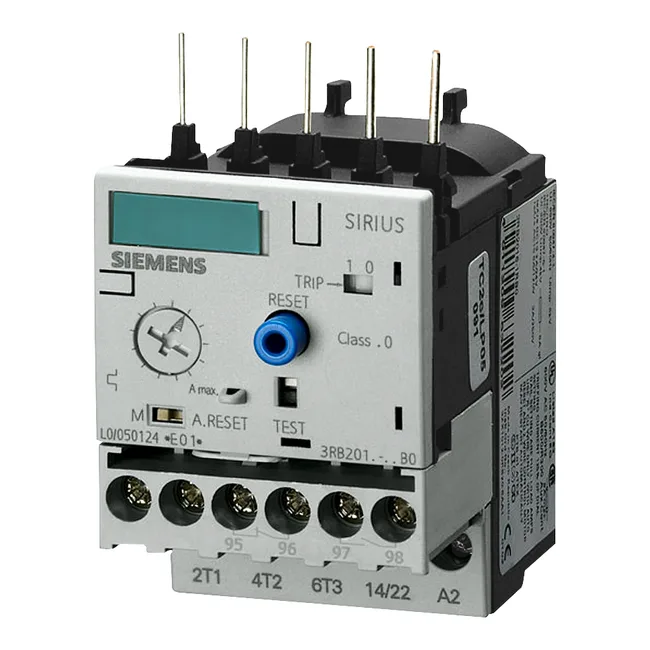
The Siemens 3RB2016-2PD0 is a SIRIUS solid-state overload relay — three-pole, CLASS 20E, with one NC auxiliary contact and screw-type main terminals plus spring-loaded auxiliary/control terminals. CLASS 20E means the relay will trip within 20 seconds at 7.2× the motor's full-load current, a standard protection curve for general-purpose induction motors driving pumps, fans, and conveyors where start-up transients are moderate. The ATEX approval (PTB 06 ATEX 3001 Ex II (2) GD) qualifies it for use in potentially explosive atmospheres as a protective device associated with category 2 equipment — a key check for panel builders in Zone 1 or Zone 21 environments.
Auxiliary contact ratings and wiring
The single NC auxiliary contact is rated for 2 A at 24 V, 4 A at 120 V, and 3 A at 230 V — these are the continuous thermal current values, so the contact can handle the typical PLC input or contactor coil draw at those voltages without derating. The spring-loaded terminals accept 2× (0.25 … 1.5 mm²) solid or finely stranded wire, or 2× AWG 24–16 for the auxiliary circuit; the main circuit uses screw-type terminals. That split means the power wiring is torqued down and the control wiring is a quick push-in — a common panel-build workflow that saves time on the auxiliary side.
Fastening method is contactor mounting — it clips directly onto the front of a corresponding SIRIUS contactor (no DIN rail needed for the relay itself), which saves one DIN-rail slot per motor starter combo. The relay itself is 45 mm wide, 64 mm tall, and 73 mm deep. Shock resistance is 15g / 11 ms, adequate for most industrial machinery.
EMC and surge robustness
Surge voltage resistance is rated at 6 kV, and the unit withstands burst transients of 2 kV on power ports and 1 kV on signal ports per IEC 61000-4-4, severity level 3. That level of immunity is typical for industrial control panels connected to a 400 V distribution network without dedicated surge protection on every branch — it means the relay won't nuisance-trip or latch up from nearby contactor switching or VFD PWM noise.