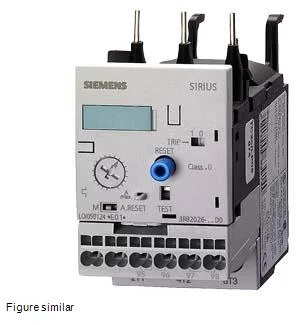
The Siemens 3RB2026-1NB0 is a SIRIUS solid-state overload relay, Class 10E, designed for contactor mounting. It provides motor protection in hazardous areas with ATEX approval Ex II (2) GD, making it suitable for use in potentially explosive gas and dust atmospheres where a safety instrumented function (SIF) demands a failsafe thermal model. The 45 mm wide housing mounts directly onto a contactor, saving DIN-rail space in a crowded panel.
This is the default for most general-purpose motor starts — a Class 10 would be faster, a Class 20 slower for high-inertia loads. The ATEX marking PTB 06 ATEX 3001 Ex II (2) GD covers both gas (Zone 1, 2) and dust (Zone 21, 22) atmospheres, so the relay can be installed in the non-hazardous side of an intrinsic safety barrier or directly in a Zone 2 area with appropriate enclosure. Auxiliary contact ratings span from 2 A at 24 V up to 4 A at 120 V and 3 A at 230 V AC — enough to switch a PLC input or a small contactor coil directly. The screw-type main terminals accept 0.5 to 4 mm² solid or 2× (0.5 to 2.5 mm²) stranded, which covers most motor-circuit wiring up to about 4 mm². Ambient operating range is -25 to +60 °C, with storage down to -40 °C; the 15g / 11 ms shock resistance means it survives panel shipping and moderate vibration on a contactor base. Surge voltage withstand is 6 kV, and burst immunity meets IEC 61000-4-4 severity level 3 (2 kV on power ports, 1 kV on signal ports). That puts it in the same EMC class as most industrial PLCs and drives — no extra filtering needed for a standard motor control center.
Mounts directly onto a contactor via the contactor-mounting interface — no DIN rail required, though the 45 mm width fits a standard DIN footprint if used with an adapter. The IP20 front face is touch-safe for panel builders; the screw terminals accept the wire sizes above. No auxiliary contacts are built in (0 auxiliary contacts), so any status feedback must come from the contactor's own aux block or an external monitoring relay.