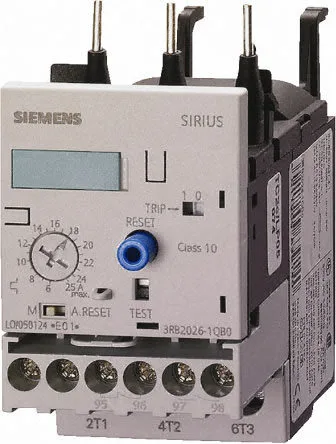
The Siemens SIRIUS 3RB2026-2NB0 is a solid-state overload relay for motor protection. It's the electronic version of a traditional bimetal overload — it monitors motor current and trips on overload, but without the thermal lag or drift you get from a heater element. The trip class is CLASS 20E, which means it's calibrated to trip in about 20 seconds at 7.2x the full-load current setting. That's the standard for standard-duty motor starting — it lets a motor accelerate under load without nuisance tripping, but still clears a stalled rotor fast enough to protect the winding insulation.
This relay mounts directly onto a contactor — the evidence lists "contactor mounting" as the mounting type. That means it snaps onto the bottom of a SIRIUS contactor, forming a compact motor starter package. The footprint is 45 mm wide, 73 mm tall, and 75 mm deep, so it's a slim unit that doesn't eat up much DIN-rail space when you're building a multi-motor panel. Side clearance of 6 mm is needed for heat dissipation — the solid-state output stage does generate some heat, so don't bury it against another heat source.
They accept solid conductors from 0.5 mm² up to 4 mm², and you can double up with 2x 0.5 to 2.5 mm² on each terminal. For AWG, that's 2x 14 to 10 AWG for the main contacts. That's enough for the motor leads on most small to medium induction motors. The auxiliary contacts — and there are zero of them built in, so any signaling needs a separate auxiliary contact block — are rated at various voltages: 2 A at 24 V, 4 A at 120 V, 3 A at 230 V, and so on. That's for the contact block you add, not the relay itself.
Environmental and protection ratings
It carries ATEX certification PTB 06 ATEX 3001 Ex II (2) GD, which means it's approved for use in potentially explosive atmospheres (Zone 2 gas, Zone 22 dust) when installed in an appropriate enclosure. It's rated for 100% relative humidity during operation, so condensation inside a non-condensing panel is fine.
Electrical robustness and EMC
It passes EMC burst immunity at severity level 3: 2 kV on power ports, 1 kV on signal ports per IEC 61000-4-4. Shock resistance is 15g for 11 ms, which covers most vibration from contactors and starters in the same panel. Power dissipation is low — 0.05 W total in hot operating state, or 0.02 W per pole — so it won't contribute much heat to the panel.