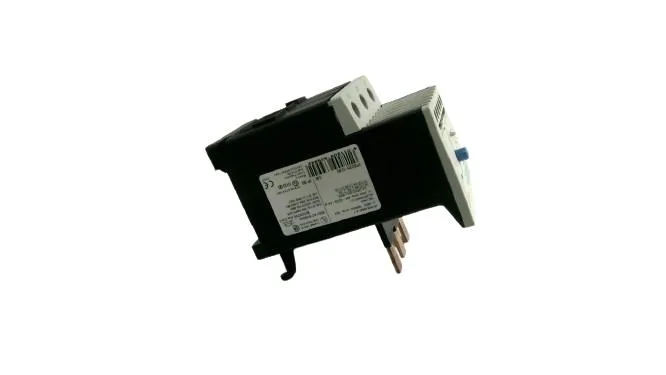
The Siemens 3RB2035-1QB0 is a SIRIUS solid-state overload relay — no bimetal strip to drift, no heater packs to swap. It protects motors against phase loss and overload by monitoring current through the main circuit and tripping the contactor coil when the thermal model says the motor is cooking. Rated for main circuit voltages up to 690 V AC-3, it mounts directly onto a contactor — no DIN rail bracket needed, no separate enclosure for the relay itself. The ATEX marking PTB 06 ATEX 3001 Ex II (2) GD means it is approved for use in potentially explosive atmospheres (Zone 1 or 21) when paired with a suitably rated contactor and enclosure.
The CLASS 10E trip curve is the headline decision point. If your motor start is hard — high inertia loads like centrifuges or crushers — you might need CLASS 20 or 30 to avoid nuisance tripping during acceleration. But for most standard motor starts (pumps, fans, compressors), CLASS 10E is the default and it works. The solid-state design also eliminates the bimetal fatigue that plagues thermal overloads after repeated starts. Mounting is contactor-mount, meaning it clips onto a matching SIRIUS contactor (typically a 3RT2 series unit). No separate base, no DIN rail footprint. The screw-type terminals for the main circuit accept solid conductors from 0.5 to 4 mm² (or 2× 0.5 to 2.5 mm²) and stranded up to 35 mm² — plenty of range for the motor leads it is sized to protect. Auxiliary contacts are not built in — the 3RB2035-1QB0 has zero auxiliary contacts on board. For remote signalling (trip alarm, status), you need a separate auxiliary contact block that mounts on the relay. Factor that into your BOM if the panel uses a PLC input to flag overload trips.
Integration notes
No side clearance needed if mounted next to another device (0 mm upwards, forwards, backwards, downwards per the spec), but the datasheet calls for 6 mm at the side for cooling airflow. Shock rated at 15g for 11 ms — tough enough for the panel on a vibrating conveyor line. Power dissipation is minimal: 0.05 W total in the hot operating state (0.02 W per pole). That means no derating headache for heat buildup inside a sealed enclosure — the relay contributes almost nothing to the thermal budget.