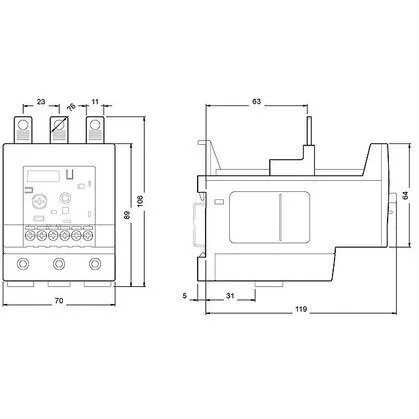
The Siemens 3RB2046-1UB0 is a SIRIUS solid-state overload relay — it protects three-phase motor circuits by monitoring current and tripping if an overload condition persists beyond the CLASS 10E curve. Three poles for the main current circuit, with screw-type terminals on both the main and auxiliary/control sides. The main terminals accept solid wire from 0.5 to 4 mm² (or 2x 0.5 to 2.5 mm²) and stranded from 10 to 70 mm² (or 2x 10 to 50 mm²). AWG equivalents: 2x 10 to 1/0, or single 10 to 2/0. Auxiliary terminals take 2x 20 to 14 AWG. Mounts directly onto a contactor via the fastening method — no separate DIN-rail bracket needed, which saves panel space. Clearance: 0 mm upwards, forwards, and backwards; 6 mm at the side.
The auxiliary contact ratings tell you what control voltage the relay can switch. At 24 V it handles 2 A; at 120 V it handles 4 A; at 230 V it handles 3 A. For DC loads: 0.55 A at 60 V, 0.3 A at 110/125 V, 0.11 A at 220 V. Surge voltage resistance rated at 8 kV, and immunity to electrical fast transients (burst) per IEC 61000-4-4 at severity level 3: 2 kV on power ports, 1 kV on signal ports. That means it's designed to hold up in industrial environments with switching transients from contactors and drives. Shock resistance rated at 15 g for 11 ms, so it can handle the vibration you'd see on a machine-mounted panel or near a large motor. Relative humidity during operation up to 100 %, including condensation — no derating needed for wet environments.
Where it goes and compliance
This is a solid-state overload relay for the SIRIUS family, designed to sit between a contactor and the motor in a standard motor starter assembly. The ATEX approval (PTB 06 ATEX 3001 Ex II (2) GD) means it can be used in the control circuit of equipment installed in potentially explosive atmospheres — it's associated apparatus, not the field device itself, but it allows the starter to be part of a certified safety chain. Substance prohibitance date of 07/01/2006 aligns with RoHS compliance (no date-specific RoHS statement, but the date matches the EU RoHS exemption sunset).