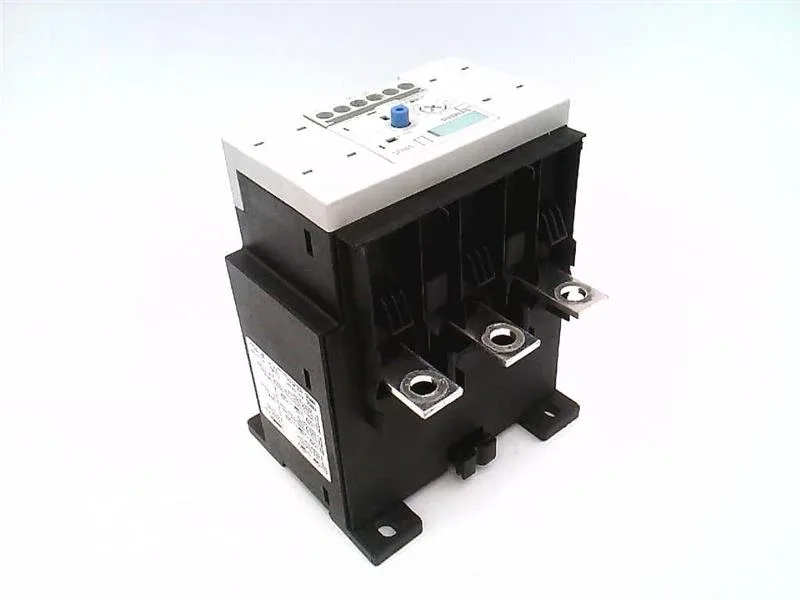
The Siemens SIRIUS 3RB2055-2FC2 is a solid-state overload relay, part of the SIRIUS family, designed to protect motors and other loads against prolonged overcurrent conditions. It uses a CLASS 20E trip curve, meaning it allows a 20-second trip time at 7.2x the current setting — standard for moderate-inertia loads like pumps and compressors. The relay mounts either directly onto a contactor or standalone on a DIN rail, giving the panel builder flexibility in layout. Rated for a maximum operating voltage of 1 000 V AC-3 and with a surge voltage resistance of 8 kV, it fits into 400 V and 690 V industrial networks without additional surge suppression for most installations.
The CLASS 20E trip class is the headline rating: it defines how fast the relay opens on a severe overload. For a motor starting a high-inertia fan, a CLASS 20E relay gives enough time for the inrush to decay without nuisance tripping, while still protecting the motor from sustained overcurrents. The relay's solid-state design means no heating elements to age or drift, and the power dissipation per pole is only 0.02 W in hot operating state — negligible for panel thermal budget. The auxiliary contact ratings cover common control voltages: 4 A at 120 V AC, 3 A at 230 V AC, and 2 A at 24 V DC — enough to switch a PLC input or a small contactor coil directly. The relay carries ATEX approval (PTB 06 ATEX 3001 Ex II (2) GD), so it can be installed in the safe area of a zone 2 gas or zone 22 dust hazardous location, protecting motors in the hazardous zone. This is a key differentiator for petrochemical and grain-handling applications where standard overload relays cannot be used.
Mechanical and environmental integration
The front face is IP00 (no protection against dust ingress), so it must be installed inside an enclosure with at least IP54 to keep the terminals clean. Side clearance to adjacent devices is 6 mm, which is tight enough for dense panels. Wire range accepts solid conductors from 0.5 to 4 mm², and with ferrule processing from 0.5 to 2.5 mm² — covers standard motor-circuit wiring. The main current circuit uses busbar connection, not screw terminals, so plan for busbar taps rather than ring lugs. Operating temperature range is -25 to +60 °C, storage and transport range is -40 to +80 °C, and it withstands 100 % relative humidity — suitable for unconditioned electrical rooms in most climates.