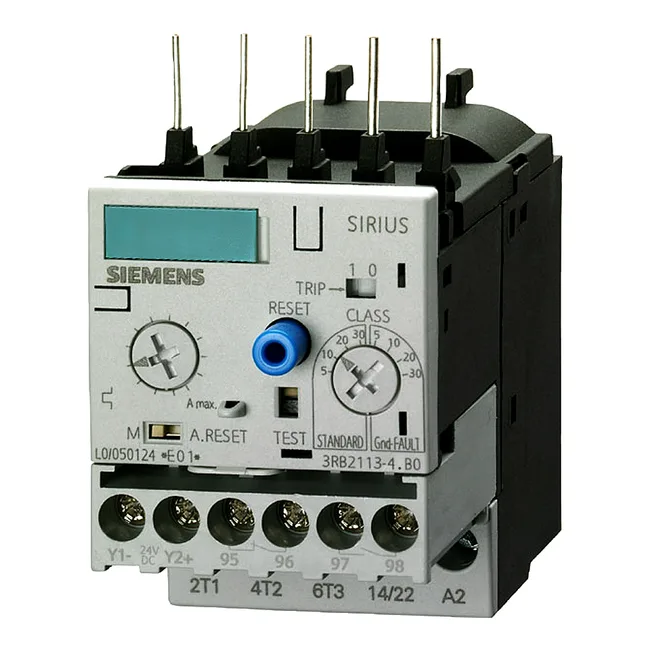
The Siemens 3RB2113-4ND0 is a SIRIUS-brand solid-state overload relay for three-phase motor circuits. Unlike a bimetallic thermal overload, this uses a solid-state sensing circuit with adjustable trip classes — selectable between CLASS 5E, 10E, 20E, and 30E — so you match the trip curve to the motor start profile: fast for submersible pumps or compressors that accelerate quickly (5E), slower for high-inertia loads like fans or centrifuges (30E). It carries ATEX approval PTB 06 ATEX 3001 Ex II (2) GD, meaning it can be installed in the non-hazardous part of a circuit that controls equipment in a Zone 1 or Zone 2 gas or dust atmosphere — the relay itself sits in the safe area but protects motors in the classified zone. That's the main differentiator from a standard thermal overload; the solid-state design also eliminates the mechanical fatigue of bimetal heaters over repeated starts.
The relay mounts directly to a contactor (Fastening Method: Contactor mounting) and occupies a 45 mm wide footprint. Depth is 73 mm, height 64 mm. Mounting position is any. Main circuit terminals are screw-type (2x 0.25…1.5 mm² solid or 2x 18…14 AWG); auxiliary and control circuit terminals are spring-loaded (2x 0.25…1.5 mm² or 2x 24…16 AWG). The spring-loaded aux terminals are a time-saver on the wiring bench — no screwdriver torque check needed, and they hold under vibration better than screw clamps in a panel next to a contactor. Auxiliary contact ratings are given across multiple control voltages: 2 A at 24 V, 4 A at 120 V, 3 A at 230 V, and lower values at 60 V, 110 V, 125 V, and 220 V. The 4 A at 120 V figure is the highest thermal current — useful for driving a PLC input or a small contactor coil directly without an interposing relay. Surge voltage resistance is rated at 6 kV, and conducted burst immunity per IEC 61000-4-4 is 2 kV on power ports and 1 kV on signal ports (severity level 3). That means the relay can be wired into a panel with contactors and drives without external surge suppression for most industrial environments. Shock resistance is 15g / 11 ms; operating temperature range is -25 to +60 °C, storage/transport -40 to +80 °C, and relative humidity during operation up to 100 %. The 100 % RH spec means it handles condensing environments — unheated pump houses, washdown zones — without derating.
Mounting: clips onto the contactor — no DIN rail required, no extra bracket. The 0 mm spacing upwards/forwards/backwards/downwards means it sits flush against the contactor face; side clearance of 6 mm is needed for auxiliary wiring access. Wiring: main circuit screw terminals accept 2x 0.25…1.5 mm² or 2x 18…14 AWG; auxiliary spring terminals accept 2x 0.25…1.5 mm² or 2x 24…16 AWG. Finely stranded wire with ferrule is preferred for the spring terminals — strip length is standard 8-10 mm. No special tools beyond a screwdriver and a ferrule crimper. Power dissipation per pole is 0.02 W — negligible for thermal panel design. The relay's own heat generation won't affect adjacent components even in a densely packed enclosure.