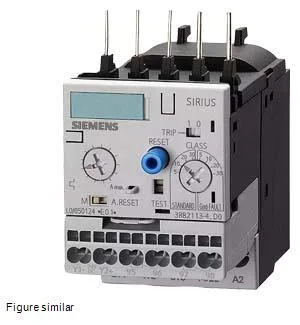
The Siemens SIRIUS 3RB2113-4RD0 is a 3-pole solid-state overload relay for motor protection in hazardous and industrial environments. It carries PTB 06 ATEX 3001 Ex II (2) GD certification, per IEC 60079, confirming it for Zone 1 gas and Zone 21 dust atmospheres when installed in the appropriate enclosure. This is not a field device — it mounts directly to a contactor via the contactor mounting fastening method, so the Ex marking applies to the relay itself as a component inside a certified assembly. Trip class is field-adjustable across CLASS 5E, 10E, 20E, and 30E, letting you match the thermal curve to the motor start profile — 5E for fast-acting protection on short-start loads, 30E for high-inertia starts like fans or centrifuges. The solid-state sensing eliminates the mechanical fatigue of bimetal relays, which matters in high-cycle or vibration-prone applications.
Fastening method is contactor mounting — it clips directly onto the matching SIRIUS contactor, no DIN rail bracket required. Width is 45 mm, height 64 mm, depth 73 mm. Solid and finely stranded conductors with core end processing are accepted at 2x (0.25... 1.5 mm²) for the auxiliary contacts. For AWG, the auxiliary contacts accept 2x (24... 16). The main circuit conductor range is not detailed here, but the screw terminals are sized for typical motor-circuit wire gauges.
Electrical ratings and environmental tolerance
Auxiliary contact ratings are given per voltage: 2 A at 24 V, 4 A at 120 V, 3 A at 230 V. The NC contact count is 1; there are no CO contacts. EMC immunity includes 2 kV burst on power ports and 1 kV on signal ports per IEC 61000-4-4, severity degree 3 — sufficient for industrial panel environments with contactor switching and drive noise. Relative humidity during operation up to 100 % — no derating required for condensing conditions. Shock resistance is 15 g for 11 ms. Power dissipation per pole is 0.02 W, negligible in a contactor stack.