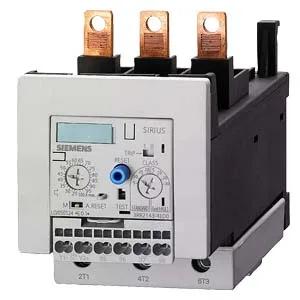
The Siemens 3RB2143-4ED0 is a SIRIUS solid-state overload relay for three-phase motor protection. It mounts directly to a contactor (contactor mounting), so it integrates into a motor starter package on a DIN-rail or panel backplate without extra bracketry. Three poles for the main current circuit, with screw-type terminals on the power side and spring-loaded terminals on the auxiliary/control side. The auxiliary terminals accept 2x (0.25–1.5 mm²) solid or finely stranded with ferrule, which covers common control-wiring sizes.
Trip Class Adjustability — What It Means for Motor Protection
Trip class is adjustable across CLASS 5E, 10E, 20E, and 30E. That means you set the maximum time the relay allows locked-rotor current to flow before tripping — 5 seconds for fast protection (e.g., submersible pumps), 30 seconds for high-inertia loads (e.g., centrifuges or large fans). One relay covers multiple motor start profiles, reducing SKUs on the shelf.
Environmental and Electrical Robustness
Rated for 100 % relative humidity during operation, so it handles condensation-prone enclosures without derating. Shock resistance is 15g / 11 ms, typical for industrial panel vibration. Surge voltage resistance rated at 8 kV, and EMC burst immunity meets IEC 61000-4-4 severity level 3 (2 kV on power ports, 1 kV on signal ports). That means it's unlikely to nuisance-trip from switching transients on the same panel bus.
Carries ATEX certification PTB 06 ATEX 3001 Ex II (2) GD, so it's approved for use in potentially explosive atmospheres — zone 2 gas and zone 22 dust applications when paired with an appropriate motor. RoHS compliance date is July 1, 2006, covering the EU directive.
Dimensions: 70 mm wide, 106 mm high, 124 mm deep. Mounting position is any orientation. Clearance: 0 mm upwards, forwards, backwards, and downwards — so it can be stacked directly against adjacent devices without air gap. Side clearance is 6 mm, which is typical for finger-duct or wire-bundle routing.